“Dundon is a finished ball player, said (Charles) Comiskey. “He is as clever a fielder as you will find in the country, and, what is more, he knows every trick of the trade. We will find a place for him on the team.”
“Great Ball for the South Side,” Chicago Inter Ocean, March 20, 1904: 17.
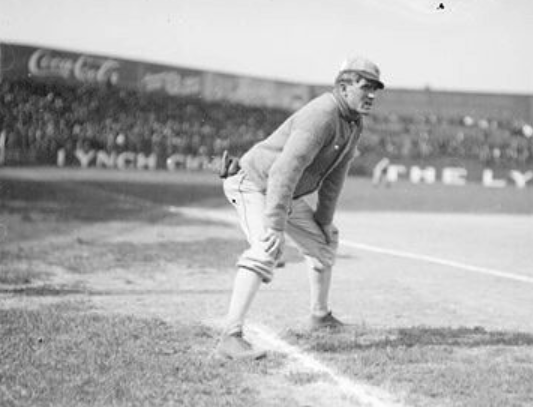
Augustus Joseph Dundon was a second baseman – a light hitting, good glove, smart infielder, perhaps you have seen one or two before – on the Chicago White Sox from 1904 to 1906. In the year of the Hitless Wonders, Dundon was the hitless-est. Only one pitcher, Roy Patterson, had a lower batting average than Dundon’s .135, and one outfielder, Frank Hemphill, batted .075 but only in 40 at bats. (Hemphill also had nine walks, though, so his OBP was 50 points higher.) Dundon’s hitting was so poor, the Sox let him hang out with the semi-pro lot until he was needed down the homestretch. That said, he saw no action in the 1906 World Series and his major league career ended.
Born in Columbus, Ohio on July 10, 1874 to Edward and Katie (Sullivan) Dundon, Gus was the sixth of seven children born to the foreman of a gas works plant and his very busy wife. According to Geneanet, Gus had two half-siblings when his Edward remarried following the death of Katie. Gus began playing in local sandlot teams and amateur teams before landing his first baseball paycheck. One newspaper reported that Gus was the younger brother of Edward Dundon, a deaf-mute pitcher from the previous decade – but that wasn’t the case. He took up the game of ball while a student, but by 1895 was pitching and playing the infield for a semi-professional team in Maryville, Ohio.
Dundon started playing professionally in the 1890s. His three years with the White Sox were but a small part of his longer baseball career, which included dozens of stops in cities big and small all over America between 1896 and 1915. He spent a few years in Denver where he played third base and managed the club, then signed a contract with the White Sox at the end of the 1902 season. However, he stayed in Denver for 1903 and the Sox didn’t make a fuss about it until August 1903 when they decided he was needed ASAP. The Sox didn’t get their wish, however, because when they sent away for Dundon to join the team, Dundon was packing for a trip back to Pittsburgh to take care of his sick wife.
Most days you could find Dundon around a baseball field – except when the odd malady came around. He nearly missed the beginning of the 1905 season with an attack of appendicitis. He missed the last month of the season for a different reason.
“In batting practice, Lee Tannehill accidentally let his bat slip from his fingers and it struck Dundon in the mouth with such force that the imprint of Dundon’s teeth are visible on the bat. Gus was knocked unconscious, and as no doctor was present at that time, it was half an hour before he received medical attendance. An ambulance took him to St. Clair hospital.
“For a time, it was thought that he would lose several teeth, but luckily they were only loosened, and Gus was able to leave the hospital and go to Chicago this evening. At that it will probably be several days before he is able to play.”
“Dundon Injured; Sox Take Game,” Chicago Inter Ocean, September 3, 1905: 9.
He missed part of 1907 with Minneapolis after breaking a leg. His appendix acted up a second time in 1909, requiring an operation. And, one day he and two other players missed a bus and decided to walk back to Olean after dinner. They had to walk around a stalled vehicle on a bridge – and at that moment two motorcycles plowed between the three men. The first cycle knocked Dundon over and the second ran over his back. Amazingly, he wasn’t seriously injured.
Dundon found a forever home in the Pittsburgh area, raising three children with his wife, Ida Barbara Puhl. When his baseball career ended, he resumed his life as a welder in the steel city. For a period of time, Dundon operated a baseball practice facility that included batting cages in Pittsburgh called the Casino Automatic Baseball Courts. His son Norbert (Norb) played minor league ball and coached youth and local teams in the Steel City. His younger son, Gus, Jr., played semi-professional ball in the Pittsburgh area. Daughter Roma worked as a stenographer for a number of years.
Augustus Dundon advanced to the next league following a stroke on September 1, 1940. He is buried in Northside Catholic Cemetery in Pittsburgh. (Now called Christ Our Redeemer Catholic Cemetery…)
Sources:
1910, 1920, 1930, 1940 US Census Records
Pennsylvania Death Records
Pennsylvania Marriage Records
“Findlay Won,” Marysville Tribune, July 31, 1895: 1.
“Weekly Gossip About Sporting,” Pittsburgh Post, December 13, 1896: 8.
“New Infielder for White Sox,” Chicago Inter Ocean, August 12, 1903: 13.
“Gus Dundon Gets Home Today,” Chicago Inter Ocean, April 5, 1905: 4.
“Semi-Pros Have Large Schedule,” Chicago Inter Ocean, July 22, 1906: 30.
“Gus Dundon is Stricken Ill,” New Orleans States, March 12, 1909: 1.
“Gus All Smiles Over Prospect for 1916 Team,” Olean Evening Herald, December 16, 1915: 10.
“Gus Dundon Breaks Leg,” Grand Rapids Press, June 7, 1907: 6.
“Gus Dundon is Hurt by Motorcycle,” Warren Evening Times, May 9, 1916: 3.
“Gus Dundon Starring for Pleasant Valley,” Pittsburgh Gazette Times, July 20, 1924: 22.
“Former Big Leaguer Dies,” Pittsburgh Post-Gazette, September 2, 1940: 25.


Say, hello! Leave a comment!!!