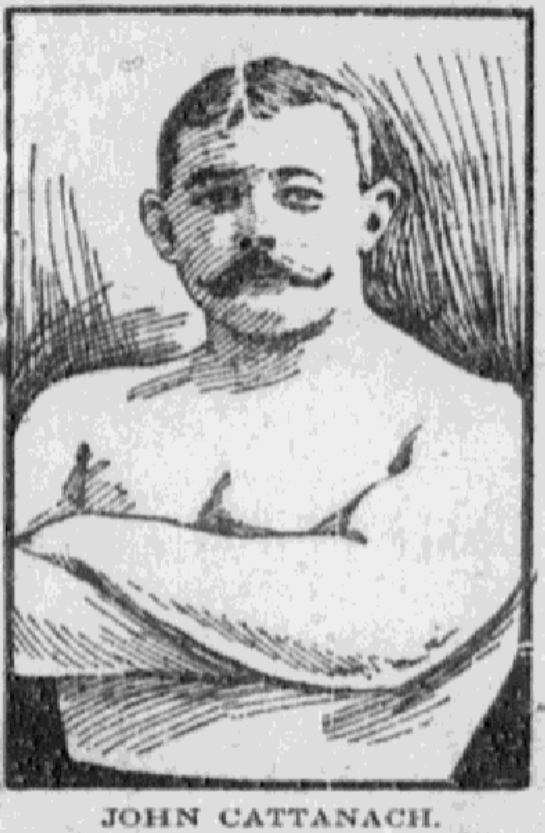
What athlete can connect late 1800s sports legends Ol’ Hoss Radbourn, William Muldoon, and Joe Choyinski?
More famous for other athletic pursuits, John Cattanach pitched briefly at the major league level with Providence in 1884 and with the St. Louis Maroons of the Union Association in the same year. Before and after his career in baseball, Cattanach took part in all kinds of sporting events.
John Leckie Cattanach entered and left this world from Providence, Rhode Island. Born May 10, 1863, he was second of six children born to Agnes Leckie and Donald Daniel Cattanach.
His father came to the United States from the Scotch Highlands around 1855, and worked as a decorative artist, chemist, and inventor. The name “Cattanach” translates to “Cat of the Mountain.” Donald’s obituary notes several chemical inventions that contributed to the manufacturing of gunpowder, which he sold when arriving in America. During the Civil War, he was hired to use his military experience to train Union soldiers in artillery applications. That said he wasn’t by nature a military man. He moved into creating art, including large frescos that appeared in churches, expensive homes and public buildings in New England. Meanwhile, he continued inventing things, from chemicals and tools for purifying water, modifications to cotton spinners, and filtration systems.
While John Cattanach studied chemistry after completing his initial education, Cattanach was destined to be an athlete. By the early 1880s Cattanach had advanced from sandlots to the local amateur teams in Providence. His natural and later developed strength was put to good use pulling the oars for the Narragansett Boat Club, where his eight-oared crew earned notice for victories and records set in Narragansett Bay and, later, on the Potomac River. He was even considered good enough to make a run at the national single scull championship.
Testing his strength in various field events, Cattanach put his strength into throwing the shot put and the hammer. He trained with the locally famous Professor Work, who set up a gymnasium used by the Boat Club, the Providence Grays and other amateur, college and professional athletes needing to get in shape or learn gymnastics, combat arts, and other athletic skills. Cattanach used Work’s Gymnasium for all of those sports and more.
Cattanach started the 1884 season pitching for Willimantic, a minor league post in the Connecticut State League. Providence borrowed his muscled right arm to make a single start for Providence against Philadelphia but they lost 9 – 8. Wildness (and errors) contributed to giving up seven runs in five innings – and a trip to play right field for the remainder of the game. “Cattanach pitched a swift and at time curving ball, but it was evident that he has not yet gained sufficient control of the sphere to be effective.”
“Sporting Varieties,” Fall River Daily Herald, June 6, 1884: 4.
After returning to his Connecticut State League team, St. Louis gave Cattanach two starts on consecutive July days in Boston when their own starting pitchers needed a breather. Cattanach split the two starts – allowing five runs in each game. In the first, he lost, 5 – 1. In the second, he won 9 – 5. Facing lesser competition in the Union Association, his statistics (17 innings, 2.12 ERA, 13Ks and a sub 1.00 WHIP) look at least superficially better.
Cattanach spent one more year playing on a professional nine, spending part of the 1885 season with Columbus in the Southern League.
After his baseball career, Cattanach toured the United States as an athlete – eventually landing in San Francisco in 1888 where he met and watched boxer Joe Choyinski train. Cattanach left the bay area wanting to try his hand at pugilism. Returning to Providence and Professor Work, Cattanach took on a number of amateur and professional challenges in the late 1880s and 1890s – losing far more than he won.
His biggest win was a 13th round knockout of middleweight Tom McCarthy at the Metropole Athletic Association in Providence on October 25, 1892. At 178 pounds, Cattanach outweighed his more experienced (and betting favorite) opponent by 14 pounds, but reporting suggested that McCarthy seemed larger in the ring. Weeks later, Cattanach got to box an exhibition with Joe Choyinski at a benefit.
The longest fight Cattanach survived was a 25-round bout with Jim Dolan in Providence. The fight was ruled a draw because both fighters were still standing at the end of the 25th round, though Cattanach was reported to have had the advantage for much of the fight. Cattanach beat Jimmy Doherty (WKO10) in a glove match that include six knockdowns in the final round before Doherty was “…unable to rise out of sheer exhaustion.”
And his most famous professional opponent was his initial impetus for boxing professionally – Joe Choyinski.
Choyinski was one of the greats of the day, fighting the likes of Gentleman Jim Corbett and Bob Fitzsimmons and Tom Sharkey and Philadelphia Jack O’Brien and George Godfrey and Marvin Hart and a very young and inexperienced Jack Johnson. That’s at least five champions of one kind or another… The fight between Cattanach and Choyinski wasn’t any good. Other than having Jake Kilrain as a referee, Cattanach was there to take a purse and get out as quickly and painlessly as possible. He went down twice in the first, then a final time in the second round on less than concussive punches, earning rightful jeers from the crowd.
Cattanach was also an accomplished wrestler. In 1887 he was matched with the touring William Muldoon in a Greco-Roman wrestling match in Boston. Muldoon already had an international reputation as a Greco-Roman wrestler and later famously trained John L. Sullivan for his 75 round boxing match against Jake Kilrain. “When the men appeared on the stage at the close of the regular performance, it was seen that Cattanach was much smaller than his opponent. Nevertheless he was a very muscular looking man and gave Muldoon a good battle for ten minutes.” Muldoon easily dispatched the eager Cattanach and threw Cattanach with ease. (Muldoon was undefeated as a wrestler from 1880, when he won his heavyweight championship until his retirement from the sport in 1890.)
To pay the bills, Cattanach’s adult life involved working in his father’s lab, his professional athletic career, and – after he retired from professional competitions – working as a laborer in Providence. He never married nor produced progeny.
According to his death certificate Cattanach died November 10, 1926 in his boarding house bedroom on Friendship Street in Providence from cancer of the liver and stomach. He’s buried (without a headstone) in Oak Grove Cemetery in Pawtucket.
Notes:
1870, 1880, 1900, 1920 US Census Records
Rhode Island Birth Records
Rhode Island Death Certificate
“Providence,” Fall River Daily News, May 24, 1882: 2.
“Providence,” Fall River Daily News, August 1, 1882: 2.
“Sporting Varieties,” Fall River Daily Herald, June 6, 1884: 4.
“Base Ball,” Holyoke Daily Transcript, July 16, 1884: 2.
“Boston Unions, 5; St. Louis Unions, 1,” Boston Globe, July 17, 1884: 4.
“St. Louis Unions, 8; Boston Unions, 5,” Boston Globe, July 18, 1884: 5.
“Muscular Scots,” Boston Globe, August 28, 1885: 5.
“Irish Athletic Contest,” Fall River Globe, September 18, 1885: 1.
“John Cattanach Thrown,” Boston Globe, December 17, 1887: 3.
“Sporting,” San Francisco Morning Call, September 16, 1888: 8.
“Match at the Metropole,” Providence News, August 26, 1892: 8.
“Cattanach Beat M’Carthy,” Providence News, October 25, 1892: 3.
“Cattanach and Choyinski,” Providence News, December 8, 1892: 8.
“In Sporting Circles,” Providence News, January 11, 1893: 5.
“Cattanach Laid Down,” Brooklyn Times-Union, June 4, 1895: 8.
“Has Speed and Science,” Pawtucket Evening Times, April 29, 1899: 2.
(Also photo source.)
“D. D. Cattanach Dead; Inventor and Decorator of Note,” Providence Evening Bulletin, January 11, 1909: 3.
“John L. Cattanach Dead at Age of 63,” Providence Journal, November 11, 1926: 18.
“Was All Around Athlete,” New Bedford Standard-Times, November 11, 1926: 18.
“John L. Cattanach was Veteran Athlete,” Hartford Courant, December 6, 1926: 10.


Say, hello! Leave a comment!!!