In the summer of 1884, Andrew M. Thompson took over the business management of the St. Paul White Caps. Months later, the White Caps were invited to join the Union Association; the final few weeks of that season mark the only time St. Paul sported a major league franchise. However, that franchise never played a major league game at home.
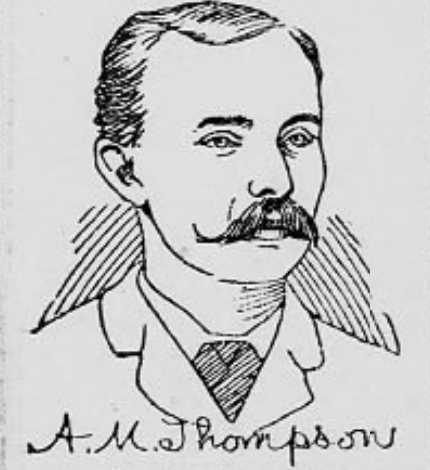
Thompson grew up in rural Winnebago County, Illinois, arriving in Seward on November 9, 1846, but spending a good portion of his life in Pecatonica. His father, Augustus, was an enterprising and curious sort. Among his adventures were two years trying to find gold in California (the trip went from Illinois to New York to Havana to Panama and finally San Francisco) and an attempt to set up a business near what is now Colorado Springs. Thompson put together his own team of volunteer soldiers in the Great War for Slavery, representing a cavalry unit in the 74th Illinois Infantry. Eventually promoted to captain of his unit – Augustus would be referred to as Captain Thompson for the rest of his days. He also created and disbanded many other less exciting businesses. His start was as a farmer and sawmill operator, but he accumulated various ventures during his nearly nine decades on this planet. He married Maria Wells – Andrew was the first of four children born to the couple.
Back to Andrew’s story, he was but 18 (though his registration form says he was born in 1845 – so maybe 19) when he registered for the Great War for Slavery himself. He served a brief run (but saw action) as a drum major for the 13th Illinois Infantry as it made its way through Tennessee. His 100 days ended in late 1864 and he took up farming and working as a saloon keeper. He then moved to St. Paul, Minnesota where Thompson invested smartly in real estate and set up a profitable liquor store on Jackson Street. He married Mary Righter; they had two sons. Andrew and his family moved back to Pecatonica around 1893.
Pecatonica is near Rockford, Illinois – and in the years following the Great War for Slavery Rockford was a baseball city. Albert Spalding and Cap Anson were among those who got their starts in major league baseball there. Andrew Thomson was another who took up the amateur game, usually playing second base or catcher. Thompson was listed at 5′ 8″ and 150 pounds and youthful looking – one article suggested he looked ten years younger than his real age in 1888.
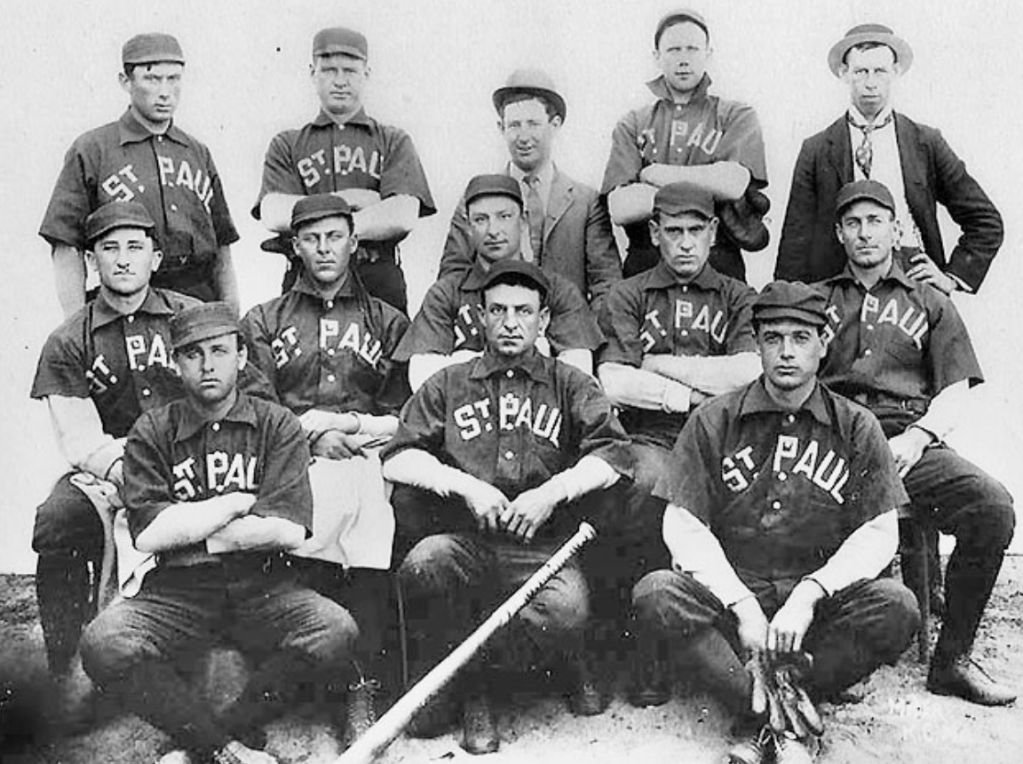
Andrew brought his interest in baseball to St. Paul. He became an investor and director of St. Paul area teams, including the St. Paul White Caps, who played in the Northwestern League in 1883 and 1884. As the 1884 season wound down, most of the teams disbanded, leaving Milwaukee and St. Paul looking for games. At the same time, two of the weaker franchises in the Union Association also disbanded and both Milwaukee and St. Paul were invited to join the Union Association to finish the schedules for those two teams.
The teams were not treated equally. For starters, the Milwaukee team was better (they had three major league caliber pitchers) – and likely better funded. The twelve games Milwaukee played were all home games, so they made some money being able to keep the larger share of their gate receipts. St. Paul, however, played all of their games on the road, collecting only the $75 per game visitors cut. Expecting to play twelve games, the White Caps played but nine – winning two and tying one. One of their wins, however, was a sharply played defensive battle over the Union Association champion St. Louis Maroons. Andrew Thompson assumed the business manager role for St. Paul that July, hence he is listed as the manager for the team in your baseball encyclopedias and websites.
Thompson stayed involved in the St. Paul baseball scene. In time he became team president for the St. Paul Apostles entry in the Western Association during the late 1880s. In 1887, he bought a half-interest in the Apostles before selling his shares midway through the 1890 season. He is rightfully considered one of the pioneers of professional baseball in St. Paul. His reward? At some point, the team fell upon hard times; Thompson’s wealth evaporated with the team’s debt and he eventually returned to Pecatonica to live with his parents. (One hopes that the City of Baseball Museum in St. Paul remembers Thompson’s contributions to St. Paul baseball.)
In the winter of 1895, Thompson was steering a load of wood on a sleigh when his sleigh tipped over dumping its goods and driver. The sleigh landed on Andrew, who suffered severe head and back injuries. Captain Thompson arrived on the scene to extricate his son and right the sleigh, but the injuries to Andrew were too great. Never regaining consciousness in the few days after his accident, Andrew M. Thompson died in parent’s home on February 17, 1895.
Thompson is buried in a family plot in Pecatonica next to his son, Ray, who died at just seven-years-old the previous summer.
Notes:
1870 US Census
Civil War Registration Files, Illinois
Civil War Soldier Profiles
“Our Nine,” St. Paul Globe, February 7, 1884: 2.
“Incorporations,” St. Paul Globe, July 15, 1884: 2.
“Team Transferred,” St. Paul Globe, April 9, 1887: 1.
“The New Ball League,” St. Paul Globe, October 25, 1887: 1.
“President Thompson,” St. Paul Globe, March 11, 1888: 2. (Also image source.)
“Eight for Eighteen Eighty-Nine,” St. Paul Globe, December 9, 1888: 6.
“Now All Play Ball,” St. Paul Globe, April 3, 1892: 7.
“Thompson is Dead,” St. Paul Globe, February 28, 1895: 6.
Fantastic biographical information for both Andrew and Augustus Thomspon was found on their FindAGrave.com pages.
The summary of St. Paul’s existence in the Union Association was pulled from Justin McKinney’s wonderful history of that league, chapters 18 and 19.


Say, hello! Leave a comment!!!