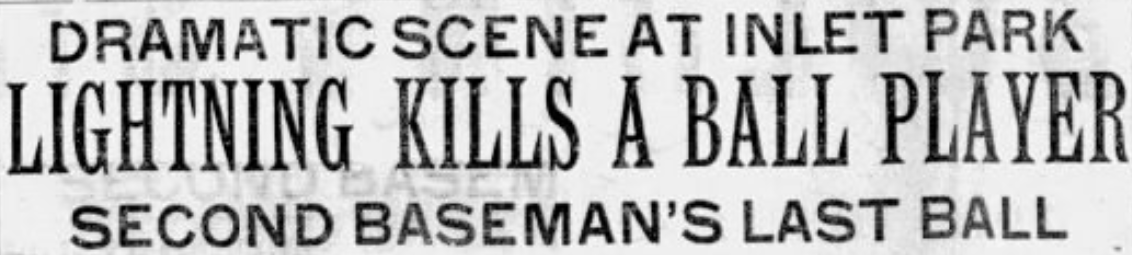
On August 26, 1909, the Cuban Giants were slated to face a collegiate nine in the second game of a recently modified three game series at Atlantic City’s Inlet Park. The first game was entertaining and competetive, won by the Giants, 12 – 10. The second game was never played – however – as tragedy befell the Cuban Giants as the teams were preparing to play.
Striking the more dramatic description, the Atlantic City Daily Press noted that William Bedford was struck by lightning as he finished making a low throw to first base during a pregame warmup that had started but three or four minutes earlier.
With his right foot in the air, lightning struck his copper cleats in the right shoe, tearing off a portion of the shoe, raced through his body, and shot out of his temple, burning a clean tear through his cap “…as if it had been cut away by scissors.” The Daily Press suggested that steam or smoke was being emitted from Bedford’s mouth. The storm had barely reached the grandstand when lightning struck, hitting someone who was hundreds of feet from the nearest building or tree.
Some 1000 spectators in the Inlet Park grandstand watched in horror. Two other players were affected by the strike. The shortstop, Walter Gordon, was shocked but fortunately not injured. Catcher Charles Follis, like Gordon, was knocked over and mildly shocked, was also lucky not to be injured.
A doctor was on scene; F. B. Coll pronounced Bedford dead and Bedford’s body was removed to the local morgue.
In contrast to the Atlantic City Daily Press, the Morris City Chronicle said Bedford had started running toward the grandstands when the rain started coming down heavily. Just then, lightning struck the ground very close to where Bedford was. In fact, most of the players ran off the field without incident. And, the Chronicle noted that both Gordon and Folles were both knocked senseless and were helped back to the stands by teammates. Most players had safely reached the stands – running head down as quickly as possible – before turning to notice Bedford’s lifeless body on the field. A handful of players ran out to Bedford, but nothing could be done.
The Daily Press article claimed Bedford hailed from Cairo, Illinois (mistakenly noted as Cairo, Arkansas), but the Paducah, Kentucky newspapers filled in those details. In fact, Bedford lived at 917 Kentucky Avenue in Paducah, not too far from the Ohio River. William Bedford played ball in Paducah before signing with the semi-professional Cuban Giants for the 1909 season and was thought to be a strong young player with a bright future.
At the time of his death, Bedford was married. In the offseason, he worked as a porter and waiter at hotel restaurants and once worked as a switchman in the local yards. He learned to play the game in Cairo and Paducah, playing amateur ball with a team of African-American athletes in Paducah for 1908. His brother, Henry, was also a member of those teams. In the few box scores I have seen for the Cuban Giants, Bedford batted in the middle of the order, usually third, fourth or fifth.
There were two rather odd coincidences that attended Bedford’s death. First, the Cuban Giants were supposed to be playing elsewhere that day. However, they cancelled another gig to stay and play two extra games in Atlantic City, where they had played competitive games in front of good crowds. Had the Cuban Giants moved along, Bedford would not have lost his life on the diamond. Also, the manager of the Cuban Giants said that this was the second straight year that one of his players lost his life to a lightning strike.
Local fans and officials with the Cuban Giants pitched in to pay for the $126 needed to send Bedford home to Cairo, where his dad lived. That said, researchers have not yet identified where William Bedford’s final resting place is located. He could be in Cairo near where his father is buried; he could be in Mounds, Illinois, near where his mother was buried.
William Bedford was born in December, 1885 in Cairo, Illinois. He was one of eleven children born to Samuel and his wife, Francis (Fannie) Bibb – though by the 1900 US Census, only seven of their children were still living and some of the children in their care had been born to Fannie when she was married to Benjamin Churchwell, an Illinois farmer. Both Samuel and Francis Bedford were likely born into slavery; Samuel arrived in Troy, Tennessee in 1846 and Francis was born in Alabama in 1848. After the Great War for Slavery ended and those slaves were freed, Samuel moved to Cairo where Samuel and Fannie would later marry in 1875. Samuel was a laborer in local mills, eventually becoming a mill fireman by 1900 before finishing his days working as a watchman at a local feed company.
Sources:
1870, 1880, 1900, 1920, 1930 US Census
Illinois Marriage Records
Illinois Death Records
https://www.findagrave.com/memorial/257185571/william-bedford
https://www.findagrave.com/memorial/274074101/samuel_c-bedford
“With Own Pistol,” Paducah Sun, October 8, 1908: 4.
“Burglar Jailed,” Paducah News-Democrat, December 1, 1908: 2.
“Score 22 Runs in Ball Game,” Atlantic City Daily Press, August 26, 1909: 3.
“Lightning Kills a Ball Player,” Atlantic City Daily Press, August 27, 1909: 1.
“Lightning Kills Ballplayer,” Morris City Chronicle, August 31, 1909: 6.
“Ball Player Killed by Lightning Bolt,” Buffalo News, August 27, 1909: 5.
“Wm. Bedford, A Negro Ballist Killed Thursday,” (Paducah) News-Democrat, August 27, 1909: 1.
“Fans Make Up Funeral Purse,” Atlantic City Daily Press, August 28, 1909: 1.


Say, hello! Leave a comment!!!