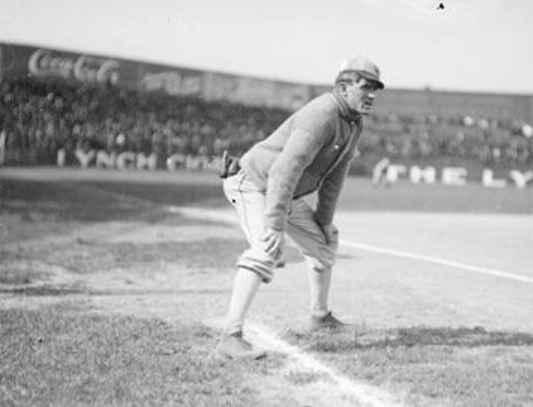
Charlie Cady was a versatile and skilled baseball prospect that didn’t quite have the goods – but he learned from his father how to broker deals in the livestock industry, skills which were much better suited for a long career.
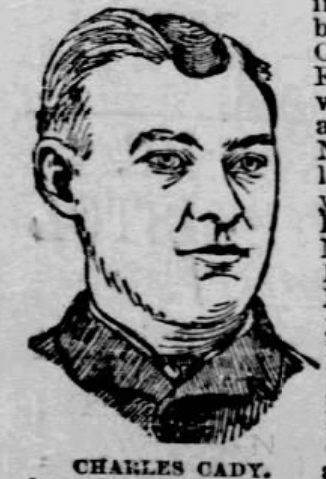
Charles Brayton (or Braton) Cady arrived on December 22, 1864 in Cambridge, Illinois, the sixth of seven children born to Samuel and Letitia (Grant) Cady. As a child, Samuel had moved to Henry County in Illinois with his family and set up a farm there. Eventually got involved in livestock trading, forming a company with his oldest son and W. M. Dunham in Peoria. They then moved to Chicago and Samuel eventually became the President of the Chicago Guarantee Fund Life Society as well as a respected member of the livestock trading community.
By 15, Charlie Cady was already working as a clerk in his father’s company – but he learned baseball in Chicago and joined the amateur teams of the city where he earned notice for both his pitching and batting skills. Cady was invited to try his hand professionally with the Cleveland Blues in September 1883. He first appeared in an exhibition game with Cleveland’s reserve team (called the Whites) and threw six good innings before things got away from him.
“Not a great deal could be judged from Cady’s work in the points yesterday. His delivery was certainly not very swift, but he showed many good points. It is to be hoped that he will prove a good one.”
“Notes,” Cleveland Leader, September 4, 1883: 2.
Still, Cleveland gave him a start against a good Buffalo lineup – and Cady was overmatched to the tune of 13 runs. He also committed four errors in the field, walked four batters, and had three wild pitches. (Wildness would plague Casy throughout his professional days as a pitcher.) Previously, Cleveland gave him two games in the outfield, but after going hitless in 12 plate appearances with but a lone walk against five strikeouts to go with his poor pitching and fielding on September 9, Cleveland gave him a return ticket to Chicago.
Cady’s MLB career wasn’t over – he would make four starts for the Chicago Unions in 1884, winning three of his four starts. However, manager Ed Hengel was not a fan of Cady’s – especially Cady’s failure to hit – and released him. (To be fair, the article that noted Cady’s release included, “There is friction in the club.”) In mid-June, Cady was in attendance when Kansas City came to Chicago. On June 17, Kansas City’s second baseman, Charlie Berry, went down and Cady was called from the crowd to play.
“In the sixth inning, Berry, while at the bat, was struck on the hand and disabled. Cady was called from the audience, and, without changing his clothes, went to the plate. The first ball that came along he raised over the centerfielder’s head, and made [Hengel] …green with envy, for Cady was the man he had dismissed because he could not bat.”
“Chicago Unions, 8; Kansas Citys, 4,” St. Louis Globe Democrat, June 18, 1884: 8.
Two days later, Cady was called upon to catch for Kansas City for a couple of innings. And so ended Cady’s major league baseball career.
He wasn’t done as a player, however. A one game tryout with Hartford failed in 1886. He spent part of that summer with Haverhill in the New England League before being released and signed by the Boston Blues – a reserve club. (Though, when he later faced Haverhill things went wrong. “A wild pitcher lost the game for the Boston Blues this afternoon. Several decisions by the umpire cost them several runs. Murphy was hit hard and Cady was not wild enough to be effective.” Ouch.)
In 1887 he spent time with Minneapolis in the Northwestern League. It was his second visit there – he made one appearance for Minneapolis in 1884 but didn’t stick. He made seven starts with Chicago in the Western Association for 1888 and lost them all. Finally, in 1889 he pitched with Burlington in the Central Interstate League but failed to impress after losing seven of twelve decisions.
So, Charlie did what a lot of kids did when the baseball dream died. He went back to the family business and started to work for dad. Cady was successful there – he would work as a livestock broker for the rest of his life, gaining a lifetime of friends in the industry.
That lifetime ended on June 7, 1909 in Kankakee, Illinois. Ill for the previous year, he died early that morning. He was buried in Oak Woods Cemetery in Chicago near his wife, the former Maud Edna Starr. Cady married Starr in 1890 in Starr’s home state of Iowa. Unfortunately, she passed away less than two years later, leaving Cady a widow for most of his adult life. The marriage produced no children.
Notes:
1870, 1880, 1900 US Census
Iowa Marriage Records
Orrin Peer Allen, “Descendants of Nicholas Cady,” C. B. Fiske & Co, Palmer, MA, 1910:386, 387
“Unions vs. Port Hurons,” Chicago Inter Ocean, July 25, 1883: 6.
“Notes,” Cleveland Leader, September 4, 1883: 2.
“Sporting Gossip,” Cleveland Leader, September 4, 1883: 2.
“Sporting Gossip,” Cleveland Leader, September 6, 1883: 3.
“Buffalo Wins,” Cincinnati Enquirer, September 7, 1883: 2.
“Sporting Gossip,” Cleveland Leader, September 10, 1883: 3.
“Diamond Chips,” St. Louis Post-Dispatch, May 20, 1884: 5.
“Chicago Unions, 8; Kansas Citys, 4,” St. Louis Globe-Democrat, June 18, 1884: 8.
“Chicago Unions, 12; Kansas City, 3,” Chicago Tribune, June 20, 1884: 6.
“Skimming the Field,” Boston Globe, August 4, 1886: 5.
“Boston Blues Defeated,” Boston Globe, August 6, 1886: 5.
“They Batted Hard, Minneapolis Tribune, August 30, 1887: 2.
“They Play Good Ball,” Chicago Tribune, June 24, 1888: 2. (Also, image source)
“Charlie Cady Dead,” Chicago Live Stock World, June 7, 1909: 1.
“Minor Mention,” Chicago Live Stock World, June 8, 1909: 1.


Say, hello! Leave a comment!!!