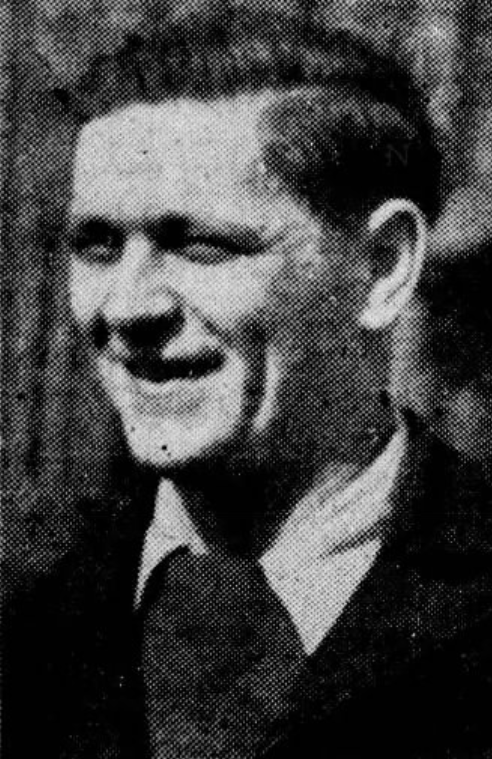
William Emory Nusz played a single game for Washington in 1884, he scored a run for the Union Association club on April 26, 1884 despite going hitless in four trips. He also made two errors in left field – meaning he was given a hasty return to his local semi-professional team within days of his major league debut.
“William Nusz, a promising ball player from [Frederick], made his appearance with the Nationals in the Boston-National game on Saturday, He seems rather slow in fielding batted balls, though sure on the fly catch. He promises under Baker’s training of becoming quite a player.”
“Our Washington Letter,” Frederick Weekly News, May 1, 1884: 3.
To be fair, Nusz was playing out of position. He was a catcher in Frederick – and a tough one.
William E. Nusz, the catch(er) for the Frederick Unions, had the thumb of his right hand split open by a hard ball, during the game with the Joel Gutman team at Agricultural park on Saturday. One of the small arteries was ruptured and the cut bled profusely. Nusz put some tobacco on the wound and bandaged it after which he took up position as right fielder. After losing an inning he returned behind the bat and kept his stand until the close of the game.
“A Plucky Catcher,” Frederick News, July 6, 1885: 3.
Born November 2, 1860 in Frederick, Maryland, Nusz came from a baseball family of sorts. At least three brothers were teammates on Frederick area teams in the 1880s. Emory played with William on a Frederick club in 1885 and Millard joined them in 1890. The dad must have had a thing for Millard Fillmore – another son’s middle name was Fillmore.
(Baseball Reference says William arrived on November 2, 1859, but given that William wasn’t listed in the 1860 US Census, I have very good reasons to believe he was born after the census taker visited the family that year.)
The brothers were the sons of Hiram and Mary Ann (Moberly) Nusz, three of eight children (six boys and two girls), a bricklayer and his busy wife. As a youth, William took on labor jobs alongside his father before becoming an electrician. A lot of the tradesmen and laborers took up baseball in the two decades after the Great War for Slavery in Maryland. William started in the 1880s and lasted until at least 1890. Most of the time he played locally, though occasionally he was signed to play elsewhere. He started 1889 with a team in Chattanooga before finishing the season with York (PA).
After his baseball career, William moved to Baltimore, working as an electrician and iron worker, among other jobs, and supporting his family.
In April 1903 he wed Amanda Morgan. What makes this odd is that Amanda is listed as his wife in the 1900 US Census, having been married for 17 years and parents of a son, Henry Fillmore Nusz, born a year after they were married. What might have happened is that Amanda was a teenaged servant in a Frederick, Maryland home where William’s father was regularly doing work for that family. In fact, Hiram had a paralytic stroke while working at various Lampe family-owned properties in 1885 that eventually killed him a year later. William, who was at least seven years older than Amanda and already a skilled laborer, worked with his father from time to time at the Lampe home. He took a shine to Amanda and they had a child together. It wasn’t until years later that he finally made the relationship legal, getting married in Washington D.C. and registering it in Baltimore.
Anyway – he had reasons to do this. In his forties William Nusz was suffering from horrible depression, supposedly due to health concerns. Given that this may have hit him from time to time, one could argue that he was bi-polar. In 1887, he punched William Rickets in the jaw, breaking it, and then went to Rickets’ home and assaulted his wife. The article noted that William was “deranged” and a brother was being treated for insanity.
Back to 1903. Years earlier he had threatened to end his life and his family had removed his revolver to prevent this from happening. In July 1903, he had a near death experience during a windstorm. The long-time electrician and laborer was among four men painting a steeple of St. John’s Church in Baltimore when a large storm blew through. The painters were nearly blown off the hanging scaffold, but all of them grabbed onto the ropes for dear life – and managed not to fall off the scaffold despite it swinging 10-20 feet from the steeple.
On July 26, 1903, just two weeks after saving his own life and one day after he bought another revolver, Nusz ended his life with a single shot to the temple. Son Henry found his father and notified the authorities, who confirmed the manner of his demise. He was buried in Loudon Park Cemetery in Baltimore.
Sources:
1860, 1870, 1880, 1900 US Census
Washington DC Marriage Records
“At the Bat,” Hagerstown Herald and Torch Light, September 27, 1883: 3.
“On Victory and One Defeat,” Washington Post, April 25, 1884: 4.
“{Illegible Headline},” Washington Post, April 27, 1884: 8.
“Our Washington Letter,” Frederick Weekly News, May 1, 1884: 3.
“Washingtons Defeated,” National Republican, May 3, 1884: 1.
“A Plucky Catcher,” Frederick News, July 6, 1885: 3.
“On the Diamond,” Frederick News, August 5, 1885: 3.
“A Paralytic Seizure,” Frederick News, May 20, 1885: 3.
“Maryland Affairs,” The Westminster Democratic Advocate, December 31, 1887: 2.
“Pungent Paragraphs,” Frederick News, August 29, 1889: 3.
“A Good Team for Frederick,” Baltimore Sun, April 25, 1890: 3.
“Storms in Frederick,” Baltimore Sun, July 12, 1903: 10.
“Shot Himself in the Head,” Baltimore Sun, July 27, 1903: 12.
“Wm. E. Nusz A Suicide,” Frederick News, July 27, 1903: 3.
“Henry F. Nusz Dies in University Hospital, Frederick News, October 11, 1951: 15.


Say, hello! Leave a comment!!!