Frank Monroe was literally the player to be named later. Twice. Which makes you wonder WHY he changed his name twice.
Frank Metcalf was born in Hamilton, Ohio around 1855. Finding him in the 1870 US Census, he was living with just his mother, Mary E. Metcalf and a younger brother, Harry. Frank was already working to support his family by taking a job with a printing company. Working backwards through Mary, we learn that she was Mary Grummon and she had married Allen B. Metcalf in Ohio in 1844. Frank was the fourth of five children born to Mary and Allen. The couple briefly moved to Alton, Illinois, where Harry was born, but returned to Ohio likely around the time Allen died. At some point Allen left Ohio to become a trader in California; records suggest he died in the early 1860s but he may have lived in California longer than that, leaving Mary to raise their children without his assistance.
The likeable and enterprising Frank Metcalf would occasionally get himself into trouble – and he would be embarrassed by these things and have to change locales and names. For example, while playing ball in Fostoria, Ohio, he got into a bit of trouble with someone else’s wife.
“A little ‘family row’ occurred on South Street last night over some disputed fire wood {SIC}, in which Mrs. John Mowry and Frank Metcalf were the chief actors. On being arrested, Metcalf stated that the woman came at him with a big stick, and afterward threw a bucket of water on him. Metcalf was unjustly fined to the amount of $15 for ‘assault and battery.’”
“Fostoria,” Cleveland Leader, August 6, 1880: 10.
Frank Metcalf became Frank Monroe and moved to California, convinced his new neighbors that he was a catcher back east (he was, if you count Piqua and Fostoria, Ohio as “back east”) and soon was playing for Fresno in an early California association. To his credit he was a pretty good catcher, and the Fresno Stars was among the best teams in the state as California began establishing more organized leagues. On the side, Frank sold cigars. With this newfound baseball success, he decided to head back home to see if he could make a new name as a professional baseball player there.
He was playing with a team in Hamilton, Ohio alongside another catcher of some skill – Harry Metcalf, his brother. They didn’t always see eye to eye – but for a couple of years, they would play ball together.
“Harry and Frank Metcalf, members of the Hamilton Base Ball Club, became engaged in a quarrel at their home on Front Street yesterday morning during their breakfast hour, in which both were somewhat used up. Warrants were issued by Mayor Saunders for their arrest, and shortly after Harry appeared at Police Head-quarters and gave himself up. He stood charged with disorderly conduct, to which he pleaded guilty, and was fined $5 and costs, which he paid. While at the stationhouse, he said the trouble between them was caused by Frank talking to his mother in a very abusive manner, and that he struck him a severe blow with his fist in the eye, putting that organ in mourning; that Frank picked up from the table a large carving knife, slashing away at his brother, cutting him across the back of the hand, laying the flesh open to the bone the entire width of the hand. Frank will be arrested and brought before the Mayor to-day.”
“Hamilton,” Cincinnati Enquirer, May 5, 1884: 7.
Monroe played well enough for Hamilton. However, he must have heard people say he had some skill (he had a decent fielding average and was batting .300). So, he approached the Indianapolis Hoosiers in the American Association about becoming their change catcher. Indianapolis, losing more than 70% of their games, were game to take a chance on both Monroe and an aging Tommy Bond. (When Indianapolis agreed, Frank asked for his release from Hamilton and was allowed to sign somewhere else.) Indianapolis let Monroe catch Bond in practice sessions to see if Bond had anything left and to see if Monroe could catch a major league pitcher.
Despite looking good in practice, neither looked good on the diamond. On July 18, 1884, Monroe was asked to play right field as Indy lost 1 – 0 to Toledo. Monroe “…had little to do in the field and failed to distinguish himself at the bat.” (He went hitless in four trips while batting fourth (!) and recorded one putout.)
Bond pitched against Toledo on July 19 and was swatted around plenty – giving up eight runs in a loss. Then, Monroe was brought in to face Cincinnati when their emergency catcher, Jerry Dorgan, “refused to catch longer, and after some discussion, Monroe, the new man, was put in. As the score shows, he was unable to hold McKeon at his best, and the latter had to ease up, much to the satisfaction of the visitors.” Monroe proved he wasn’t a major league catcher – eight passed balls and one error. The Indianapolis Journal noted, “The Indianapolis ball club needs a change catcher much worse than it needs pitchers.” Monroe soon was released.
That didn’t stop Monroe from trying to use his brief major league opportunity as a resume builder. He jumped to Chattanooga to finish 1884 and in the following season he was named their manager for that season. And, he brought along a bunch of Ohio talent with him – starting with his brother Harry, a switch-hitting catcher.
Pitcher Rob Gilks played with Hamilton in 1884. Pitcher John Ryan came from Dayton, but his brother Harry had caught Ryan for several seasons. Sim Bullas was also a catcher – he had caught Gilks and briefly played with Toledo in 1884 where he caught Tony Mullane. Centerfielder/Catcher Monroe is listed as having come from Fresno City, California, having also played with Hamilton and Indianapolis. Frank Harris played with Hamilton at third base. Deaf athlete John Ryn of Marion, OH took one corner outfield spot, John Seigle, who played in the Ohio State League, took the other. Allegheny City shortstop George Bethel rounded out the roster.
Chattanooga was one of a handful of clubs that left the Southern League to form the Southeastern League. (The new league included Atlanta, Macon, Savannah, Columbus, Chattanooga, and Montgomery.) Things didn’t start well; after losing on opening day, Macon topped Chattanooga, 19 – 2. Monroe played through the season before deciding he liked living out west better.
After a pitstop in Alburquerque, Frank Monroe took up baseball in Los Angeles. He became the captain of the Los Angeles club for two seasons. In 1888, he was back in Fresno, managing the Fresno entry in the Central California League. Fans and writers called him “Mun” and noted that Frank Monroe carried the middle initial C… When he signed with Fresno, the Daily Evening Expositor wrote that Monroe had been playing with “the celebrated Los Angeles club for the past two seasons…” with onetime Fresno pitcher Al Hapeman (the California Kid) – who spent his winters pitching in Las Vegas.
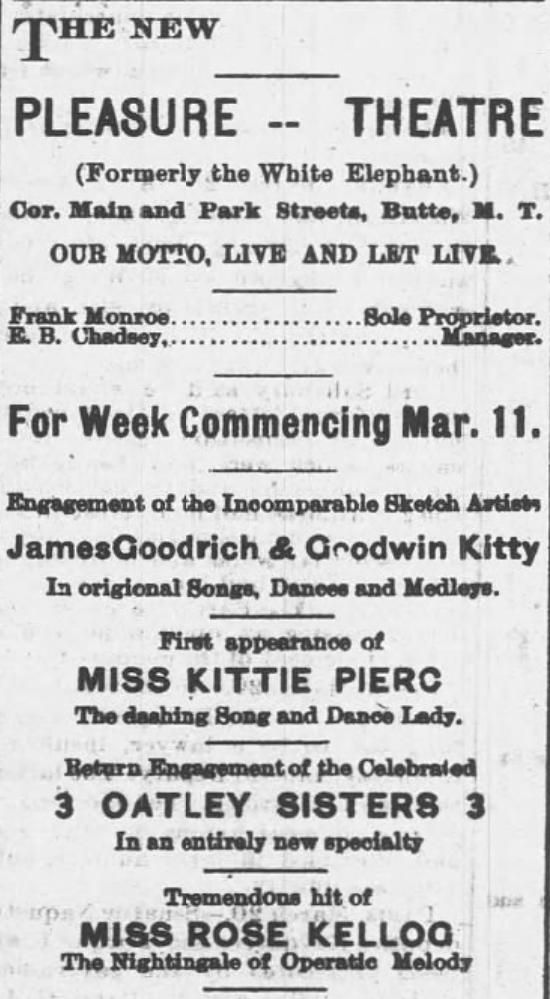
It’s at this point, where Frank Monroe’s life takes a little detour. He’s had a taste of managing baseball teams on the field, but he dreams of life as the proprietor of entertainment rather than the talent. Montana had a mining run on silver and then copper in Butte – and Frank Monroe sought to make his fortune entertaining the growing miner class. He opened the new Pleasure Theatre in Butte, Montana. There, with the motto “Live and Let Live,” he produced live shows for perhaps five weeks. And then, falling behind in cash, he ran back to Fresno to play baseball. By May, there were placements in Butte newspapers looking for Frank Monroe, who had run out without paying his bills.
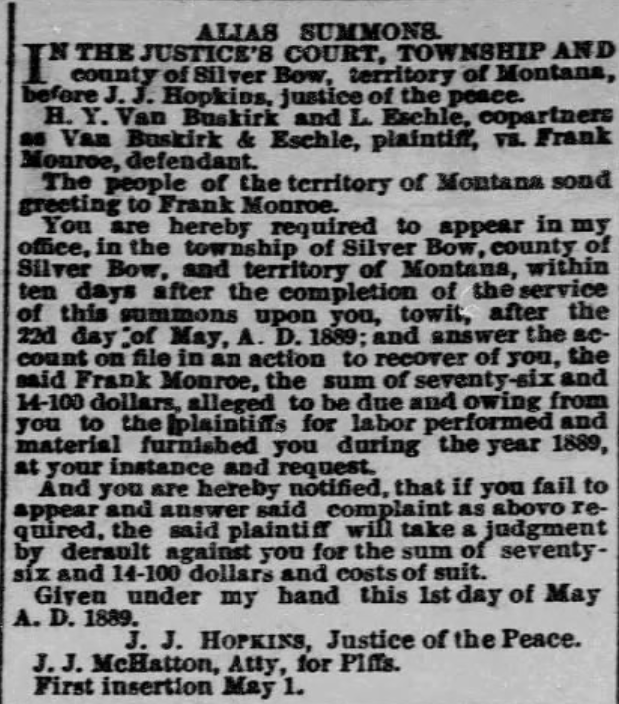
By the end of 1889, he was catching for a semi-pro club in San Diego.
You don’t see much of Frank Monroe again until January 1894, when he rents out a Music Hall in Los Angeles and does a week worth of shows there – and then runs off without paying the salaries of the people who performed for him. An informant said that Monroe had done this a few years earlier in Montana and ran off with about $2000. And he left a wife, who was not named in the article about the heist, behind.
For what it’s worth, about ten months later a man named Frank Monroe was caught forging checks from a San Francisco bank in Denver, Colorado and sent to jail. (He changed $15.00 to $1500.00) I cannot promise you that this is the same Frank Monroe, but from this point forward, Frank Monroe ceases to exist in a public manner and a Monte Monroe moves into Great Falls, Montana around 1903.
“Monte Monroe, the well known local sporting man, former champion backstop of the world, bathhouse man, and hero of 10,000 bottles, but now a resident of Alhambra and rubber extraordinary to the boil-out brigade…”
“Monte is Still Dead Game Sport,” Great Falls Leader, April 25, 1907: 5.
People knew Monte Monroe as an entrepreneur with a baseball past and a semi-regular financial problem. Monte Monroe tried multiple sports in Great Falls and Alhambra Springs with a mixture of quick success and sudden failures. He ran baseball teams with varying success on the field and at the gate. He got involved with boxing – managing fighters, organizing fight cards, and even working the corners for a handful of pugilists. Monte even coached football briefly – but this venture ended in tragedy when one of his football players was fatally injured in a pileup following a particularly hard tackle – a genuine risk of that era. When James C. Curtis died, so went the football season and Monte Monroe’s investment.
He once considered creating a dog and pony show featuring his own dog, Black Bess, who was especially adept at performing tricks.
Even without running teams, Monroe was often an umpire, unpiring games through late May 1908. Unfortunately, Monroe soon fell seriously ill after one exhibition and was eventually hospitalized. Monte knew he was dying. When friends visiting Monroe in the hospital told him they would return soon to check on him, Monte would reply that he likely wouldn’t live much longer. And he was right. Frank Metcalf – AKA Frank C. Monroe – AKA Monte Monroe – advanced to a different league on the morning of July 2, 1908.
Having gone through Monroe’s personal belongings after his death, people found letters saying his name was Frank and another person learned that his real last name was Metcalf and that he had a brother in Hamilton, Ohio. Local authorities reached out to a Sheriff Harry Metcalf back in Ohio where apparently Metcalf/Monroe had lived as a youth. Harry confirmed that this was his brother and asked if Frank had any financial problems.
Friends in Great Falls made sure that Metcalf had a proper burial in Old Highland Cemetery.
Notes:
1850, 1860, 1870, 1880 US Census
Ohio Marriage Records
Ohio Probate Records
Great Falls City Directory
“Fostoria,” Cleveland Leader, August 6, 1880: 10.
“Local Brevities,” Fresno Weekly Republican, January 30, 1883: 3.
“The National Game,” Fresno Weekly Republican, June 16, 1883: 3.
“Personals,” Fresno Weekly Republican, August 11, 1883: 3.
“Hamilton,” Cincinnati Enquirer, May 5, 1884: 7.
“Notes,” Cincinnati Enquirer, July 11, 1884: 5.
“Base-Ball Players in Trouble,” Indianapolis Journal, July 11, 1884: 3.
“One to Nothing,” Indianapolis Journal, July 19, 1884: 8.
“General Notes,” Evansville Journal, July 20, 1884: 5.
“The Base Ball Championship,” Indianapolis Journal, July 21, 1884: 8.
“Base Ball Notes,” Indianapolis Journal, July 21, 1884: 8.
“Base Ball Matters,” Indianapolis Journal, July 24, 1884: 8.
“Local News,” Piqua (OH) Daily Call, October 28, 1884: 3.
“City News,” Urbana (Ohio) Daily Citizen, December 4, 1884: 1.
“Chattanooga’s Team,” Chattanooga Daily Commercial, December 28, 1884: 4.
“City News,” Urbana (Ohio) Daily Citizen, December 4, 1884: 1.
“Base Ball,” Chattanooga Daily Commercial, February 2, 1885: 4.
“The Chattanoogas Meet Another Terrible Defeat,” Chattanooga Daily Times, April 19, 1885: 4.
“City Hotels,” Albuquerue Journal, January 31, 1886: 4.
“Base Ball Today,” Los Angeles Herald, September 5, 1886: 6.
“Round the Town,” Daily Evening Expositor (Fresno), September 6, 1888: 1.
“Baseball,” Fresno Daily Expositor, September 12, 1886: 4.
“The New Pleasure Theatre,” Butte Weekly Miner, February 27, 1889: 2.
Advertisment, Butte Miner, March 21, 1889: 2.
“Baseball,” Fresno Weekly Republican, April 19, 1889: 5.
“Base Ball,” Daily San Diegan, August 6, 1889: 3.
“Badly Wanted,” Los Angeles Evening Express, January 11, 1894: 1.
“Baseball Dope Ready for the Mixing Next Saturday,” Great Falls Leader, May 15, 1905: 5.
“Young Ketchell Wins in the Twelfth Round,” Great Falls Tribune, December 2, 1905: 4.
“Monte Munroe Takes the Coin,” Great Falls Leader, January 16, 1906: 4.
“Death of Curtis was Accidental,” Great Falls Leader, November 12, 1906: 4.
“Alhambra to the Front,” Great Falls Tribune, April 25, 1907: 4.
“Monte is Still Dead Game Sport,” Great Falls Leader, April 25, 1907: 5.
“Spray of the Falls,” Great Falls Tribune, March 29, 1908: 10.
“Rambler Defeat the Belt Miners,” Great Falls Leader, May 25, 1908: 2.
“Monte Monroe Passes Away,” Great Falls Tribune, July 2, 1908: 5.
“Brother is Located,” Great Falls Leader, July 3, 1908: 4.


Say, hello! Leave a comment!!!