“Doc Kennedy played in his usual style behind the bat, winning hearty applause for his fine pick ups.”
Buffalo Express, August 15, 1878
Arriving August 11, 1853 in Brooklyn, Michael Joseph Kennedy was the fifth of what appears to be six to eight children born to John and Johanna (Devaney) Kennedy – both Irish imports. John served during the Civil War – he is listed as a soldier in the 1865 New York Census. In 1870, he’s listed as a switchman in Hornellsville, New York, which is in the county where Michael would spend most of his future life. It’s not noted where Michael learned the game of baseball, but certainly the area had a baseball history as the game was played in the Rochester area for years prior to and after the Great War for Slavery. It’s possible that the teenaged Kennedy may have watched Harry Berthrong and Seymour Studley chase flies beyond the Rochester diamonds.
And, he would acquire a new name.
“The Riverside Club, who for the past two years have held the state championship, will… play the first of a series of games with the Memphis Club, who have had their nine strengthened by the arrival of ‘Yellow Fever Sullivan’ and Mr. Doc Kennedy.”
“Base Ball,” The Daily Memphis Avalanche, April 16, 1876: 1.
The first time we find Kennedy in a box score is with the Memphis Reds in 1876 and he stays with Memphis into 1877. However, a team closer to his New York home comes calling and he joins Rochester, a member of the International League – the first minor league in North America.
Known for his large hands, pigeon-toed walk, and strong throwing arm, Kennedy made a name for himself while with Rochester. A fan of the Rochester team remembered that Ike Van Burkalow and Kennedy formed Rochester’s ace battery at the grounds at Union and Culver Streets. (Burkalow was among the first pitchers whose windup included turning his back completely to the batter.) In addition to his catching skills, Kennedy was a fine hitter able to hit with some power to all fields.
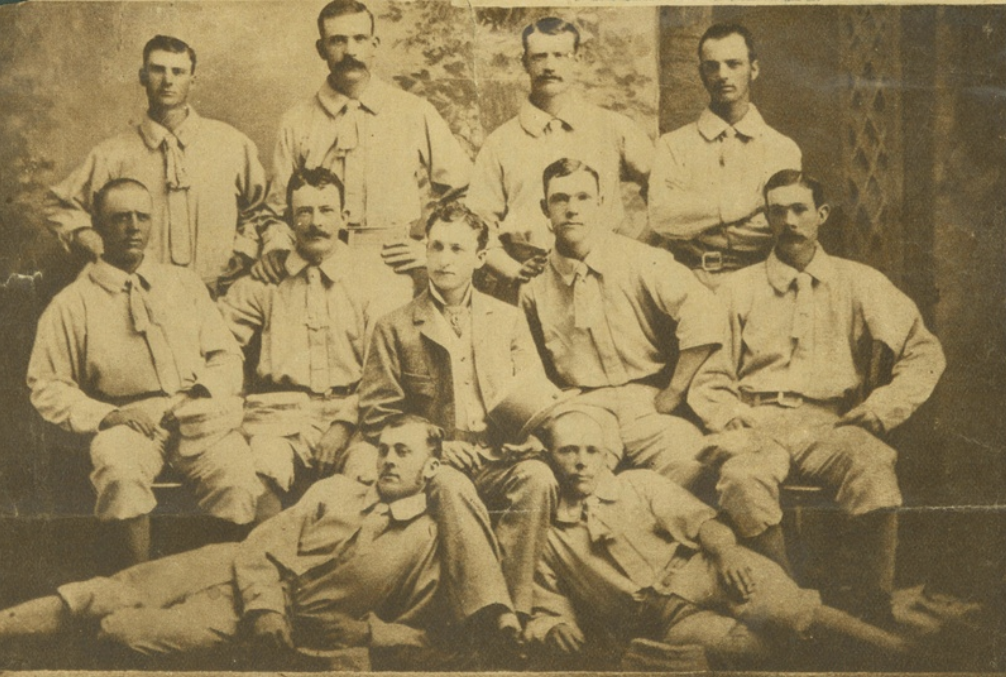
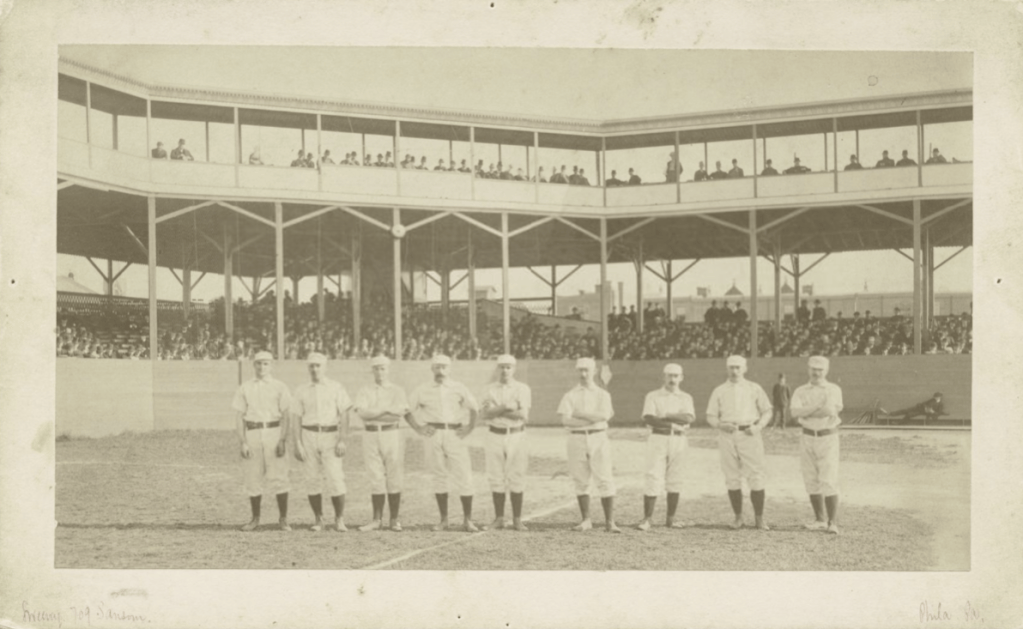
The National League’s Cleveland Blues signed Kennedy for the 1879 season. (Kennedy is at the top left in this team photo.) There, Kennedy was known for his batting skills and his seriousness. The Buffalo Express noted Kennedy was “…never known to smile…” and called him “…the ‘Lone Fisherman’ of the league.” The Lone Fisherman nickname stayed with Kennedy throughout his MLB days. That said, Kennedy batted in the middle of the Cleveland lineup.
Fans of the Blues would probably have been caught off guard when a pre-season bio of players said that Kennedy was a stocky 5′ 2″ and about 185 pounds. He was stocky, but not that stocky. He stood 5′ 9″ – but was certainly thick and strong. Despite nearly a month of his rookie campaign with a broken finger, Kennedy finished with a team leading .290 batting average, the second highest slugging percentage, and proved to be a valuable member of the Blues roster.
In 1880, he suffered a number of injuries – and he tried to play through them. In May, he was playing through a sore thumb. Then, in early July, Kennedy hit a foul ball that ricocheted off his bat into his own eye, cutting his face and injuring his eye. Three weeks later, he was playing despite his vision being affected. One account noted that “…Kennedy, with his eye half closed from the recent injuries it sustained, did his best, and this player can congratulate himself on the excellent manner he supported (Jim) McCormick.” 1880 was the only major league season where he didn’t hit. He struggled to a .200 batting average with little power.
Kennedy returned to the Blues for 1881, but as the reserve catcher and occasional outfielder. He came to camp “…as big as two mountains” which contributed to his losing his starting role to the recently acquired veteran catcher, John Clapp. Still, his bat returned to form. Kennedy would bat .313 in 39 games.
“We learn on undoubted authority that Kennedy’s arm has given out, and he has retired from the Clevelands.”
“Diamond Dust,” Cleveland Leader, April 21, 1882: 3.
He returned in fine trim for the 1882 season, but soon after the season started Kennedy lost his ability to throw. He played just a single game with Cleveland in 1882. Released, Kennedy returned home to Rochester and played first base for the semi-pro Monroes. In an exhibition against the National League Buffalo squad, Doc had three hits including a homer, and a solid performance at first base. Buffalo signed him for the 1883 season with hopes that Kennedy’s arm would return to form, but he would play just five games for Buffalo in 1883. Kennedy voluntarily retired that summer.
From this point forward, Kennedy switched from catching to playing first base. And, as he had done from the start of his career, he wouldn’t use a glove when taking the field for the next several seasons – even when using a glove became more accepted.
Strangely, despite the Union Association joining the major league ranks for 1884, he failed to find a major league job that season as a player. Much of that was due to his signing a contract with the New York Nationals, who placed him and a few other known quantities on their “reserve” team. That said, Kennedy was rarely able to play in games for the New York Reserves, earning him the nickname of ” a stayer”, meaning “(h)e could stay in a club and out of a game better than any other man on the New York nine.” That said, he did appear as an umpire in a National League game between Buffalo and New York in September 1884. Kennedy was up for umpiring jobs with the Eastern League during the 1890s. And, he would later umpire an American League doubleheader between New York and St. Louis in 1910.
Kennedy returned to the minors for 1885 and began a long run as a hired hitter. He spent time as a first baseman for the semi-professional Elmira Telegram team and an Elmira state league team. He also spent a few years playing minor league ball in Rochester. That said, many thought that Kennedy still had a major league bat years after his last major league game. An editor for The Sporting News called for both Louisville and Baltimore to pick up Doc Kennedy prior to the 1886 season. That comment came more than two years before the same magazine noted that Kennedy remained the best hitter on the Rochester club in 1888.
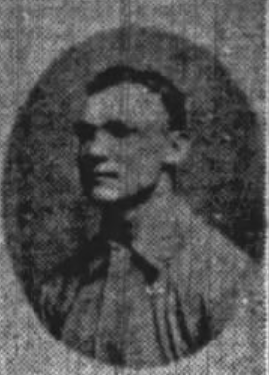
Kennedy maintained high batting and slugging averages for more than another decade. He batted .324 with Cleveland’s Western League entry in 1885, .341/.489 with Rochester in 1885, .360 with Canandaigua in the New York State League in 1889, .311 with Albany in 1891, and .294 while approaching his 40s with Albany in the Eastern League in 1893.
And he wasn’t done yet. He continued playing and managing well into his 40s. He played three straight years in the New England League for Worcester and Fall River from 1894 to 1896. In that last season for Fall River – at 42 years old – he batted .325. In 1897, he managed and played first base for Palmyra. Two years later, he was on the Johnstown roster for the New York State League and in 1901 – 1901 (!) – the 47-year-old played 37 games as a backup catcher and first baseman for Buffalo in the Eastern League. Kennedy played some form of baseball, usually getting paid for it, for at least twenty-five years.
“…(T)here were many players whose personal habits were not of a high standard. Kennedy was one of the exceptions. He never drank or smoked, and on and off the ball field he was quiet and retiring.”
Rochester Democrat and Chronicle, May 28, 1920.
While playing in Rochester, Kennedy lived and worked on a farm in Cohocton, New York which was owned by his father-in-law. Kennedy married Olive Whiting and by 1880 they had a son, John. (Not THAT John Kennedy, obviously.) In his later years, Kennedy acquired and worked a farm in Grove, NY. He and Olive had three children (John, Grace, Albert). In 1910, his daughter was no longer there, but a fourth child was being raised on their Grove farm (Raymond). One day, in 1911, Albert and Raymond were working the farm using two horses to pull a hay tedder. At some point the horses took off throwing Bert to the ground and dragging Raymond along behind. Fortunately, Bert somehow diverted the horses and rescued his brother – who suffered serious injuries to his head and back.
Continuing… By 1910 Doc was now selling cigars (again) for the Danville Cigar Manufacturing Company while his sons worked the farm. By 1920, roles switched; dad went back to working the farm and Albert became the travelling salesman.
His son, John, followed in his father’s footsteps and was a catcher based out of Rochester and frequently was called Doc like his father. He was good behind the plate, a decent hitter, but less prone to maintain his fitness. In 1907, John was given a look by the Chicago White Sox but didn’t stick.
Kennedy’s health gave out on May 23, 1920. While Kennedy’s death certificate says he died at his farm home in Grove, New York, for some reason a number of news reports say he died in Swains, New York. (If he died at Swains, he was staying at his son Albert’s house.) He is buried near family in Oakwood Cemetery in Nunda, New York.
So where did “Doc” come from?
Obviously, M. J. Kennedy was not a real doctor. In trying to find a source for Kennedy’s nickname, I have found numerous instances of an actor who appeared in stages in New York and Buffalo who went by Doc Kennedy. The theatrical Doc Kennedy also operated as a stage manager and was once stabbed by a very drunk John Shay at Blanchett’s Theatre in Philadelphia. A somewhat notorious burglar named Charley Kennedy traveled by the name of Doc Kennedy. And, there was another Doc Kennedy who got involved in Pennsylvania politics. It wouldn’t be surprising if locals just hoisted that nickname upon him because there were other Doc Kennedys at the time. His son used Doc during his career, and there was a bantamweight boxer out of Rochester who fought under the name Doc Kennedy in the late 1890s and early 1900s.
Notes:
1870, 1880, 1900, 1910, 1920 US Census
1865, 1915 New York Census
“Globe Theatre,” New York Herald, September 6, 1875: 1.
“Base Ball,” Daily Memphis Avalanche, April 16, 1876: 1.
“Attempt to Assassinate a Manager,” Buffalo Post, July 14, 1876: 3.
“Next,” Buffalo Express, August 15, 1878: 4.
“Town Talk,” Rochester Democrat and Chronicle, March 27. 1879: 4.
“Base Ball,” Cleveland Leader, April 12, 1879: 8.
“Dropped,” Buffalo Express, June 25, 1879: 4.
“Our Lockport Letter,” Buffalo Morning News, May 30, 1880: 2.
“Hip! Hip! Hurrah!,” Cleveland Leader, July 12, 1880: 10.
“General Notes,” Cleveland Leader, May 26, 1880: 8.
“Hankinson’s Hit,” Cleveland Leader, July 3, 1880: 2.
“Base Ball,” Cleveland Leader, April 2, 1881: 6.
“Diamond Dust,” Cleveland Leader, April 21, 1882: 3.
“Diamond Dust,” Cleveland Leader, June 30, 1882: 5.
“The Buffalos of 1883,” Cincinnati Enquirer, October 22, 1882: 12.
“Notes,” Cincinnati Enquirer, July 15, 1883: 11.
“Notes,” Cincinnati Enquirer, March 31, 1884: 8.
“Fair Balls,” Detroit Free Press, June 17, 1884: 3.
“Game Stopped by Darkness,” New York Times, September 30, 1884: 2.
“Notes and Comments,” The Sporting Life, January 20, 1886: 3.
“Rochester Ripples,” The Sporting News, August 29, 1888: 5.
“Dansville,” Rochester Times-Union, March 28, 1889: 6.
“Canandaigua,” Rochester Times-Union, February 28, 1890: 2.
“The Big Three,” Buffalo Times, March 6, 1897: 6.
“Palmyra Team Ready,” Buffalo Courier, March 30, 1898: 7.
“Buffalo Bits,” The Sporting News, March 30, 1901: 8.
“Rain Prevented All Contests,” Rochester Democrat and Chronicle, September 25, 1904: 23.
“Olean to Continue in League,” Rochester Democrat and Chronicle, March 28, 1907: 18.
“Yankees Win Two Games,” New York Tribune, August 21, 1910: 8.
“Boys Hurt, One May Die,” Buffalo Express, June 29, 1911: 2.
Image, Rochester Union and Advertiser, March 9, 1917: 18.
“‘Doc’ Kennedy, Former Elmira Ball Player, Passes Away at his Home in Steuben County,” Elmira Star-Gazette, May 25, 1920: 9.
“Old ‘Doc’ Kennedy is Dead; B.B. Hero of Older Generation,” Rochester Times-Union, May 25, 1920: 27.
“‘Doc’ Kennedy, Once Baseball Star, Dead,” Rochester Democrat and Chronicle, May 28, 1920: 31.
Karpe, “Commment on Sport Topics,” Buffalo News, May 29, 1920: 16.
https://www.retrosheet.org/boxesetc/K/Pkennd101.htm
Photo Source:
The Cleveland Spiders? Buckeyes? Blues? Rocks? We picked ‘Indians’ replacements – The Athletic
Image, Rochester Union and Advertiser, March 9, 1917: 18.


Say, hello! Leave a comment!!!