In a recently updated post about Adair (Paddy) Mayes, I noted that when I first wrote about Mayes I determined that he was the first player born in Oklahoma that made it to the big leagues. However, in the six-plus years since that post, researchers determined that a player named “Abercrombie” who appeared in a game for Troy in 1871 was not newspaperman Dave Abercrombie, but rather it was Rensselaer Polytechnical Institute student Frank Abercrombie who played shortstop in that game.
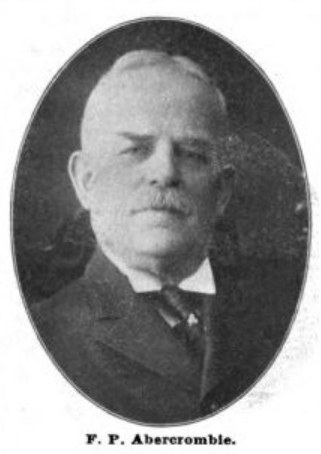
Francis Patterson Abercrombie was the fifth of nine children born to Brigadier General John J. Abercrombie and his wife Mary (Patterson). General Abercrombie moved around a lot, seeing action in the Black War, Seminole campaigns, being in charge of various western posts until the War with Mexico, and finally serving during the Great War for Slavery, mostly protecting DC and part of the Shenandoah Valley campaigns. As such, his nine children were born all over the United States depending on what fort Abercrombie happed to call home at that time.
On January 2, 1850, when Francis arrived, John J. Abercrombie was stationed at Fort Towson in Oklahoma. Before the year was out, he had been reassigned to San Antonio. In 1860, he was stationed at Fort Ripley in Todd, Minnesota but, with war obligations, he eventually moved to Washington before moving to New York when his war services were no longer required. Francis was eventually sent to St. Mark’s School in Southborough, Massachusetts and, upon graduation, he enrolled at Rensselaer in Troy, New York.
The season nearly over, the Troy Haymakers had but two games left to play against the Chicago White Stockings. However, shortstop Dickie Flowers couldn’t play and, pressed for help, Troy brought Abercrombie in for the October 21, 1871 game. According to game reports, the weather was cold and unfit for fielding, and a sparse crowd of no more than 500 people attended the contest. Abercrombie went hitless in four trips, contributing a putout and three assists – but also added two errors. Flowers returned for the final game two days later; the student returned to his engineering classes.
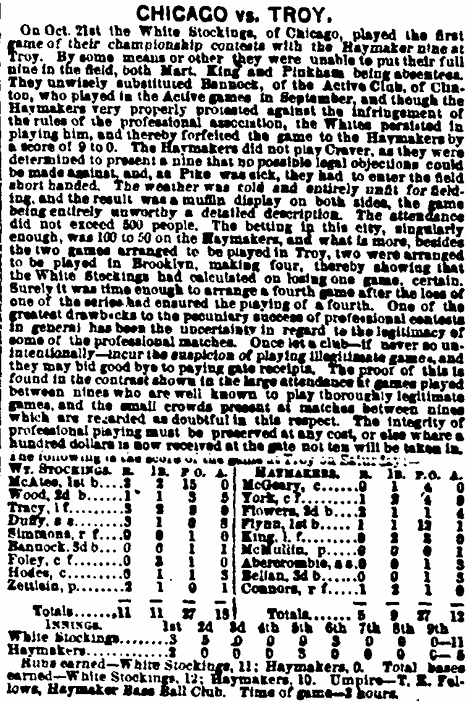
Oddly enough, there might have been a chance that Abercrombie’s appearance in that game might not have counted. Chicago, needing players, played Mike Brannock that day. Troy argued that, as a member of the Actives, Brannock was ineligible to play and filed a protest asking that the game be forfeited to Troy instead. That request was denied; the game was played and Abercrombie was eventually accurately credited in online baseball encyclopedias. (Dave Abercrombie appears in the 1951 Turkin and Thomspon Baseball Encyclopedia, was removed by later versions of the Big Mac, and was restored in Total Baseball’s encyclopedia.)
Unlike his two brothers who followed their father (and grandfather, General Robert Patterson of Philadelphia) into the United States Army, Francis took a position with the Pennsylvania Railroad, serving as an engineer and later superintendent for a number of years. In that role, he did support the US Army. In preparation for Spanish-American War, Abercrombie helped organize the encampment transportation for thousands of soldiers at Camp Alger at Middletown (near Harrisburg, Pennsylvania). He bounced around between various stops along this railroad from New York City to Harrisburg before finally taking an engineering position at a Philadelphia foundry as he approached his 70th birthday. Eventually he retired and lived out the rest of his days in Chestnut Hill, a suburb of Philadelphia.
Along the way, he married the former Ellen (Nell) Packer. They had four children whose marriages found their way into the society pages of local city newspapers. Francis was a socialite of sorts. Remembered for his kindness and active life, Abercrombie was fond of sports, promoted local baseball programs, and took an active part in local boating organizations. He was also a tenor soloist for his St. Matthew’s Episcopal Church choir.
Francis was a widower when he suffered a cerebral hemorrhage and died at his home in Chestnut Hill, Pennsylvania on November 11, 1939. He was buried in a family plot in the St. Thomas Episcopal Church Cemetery in Whitemarsh, Pennsylvania.
Sources:
1850, 1860, 1900, 1910, 1920, 1930 US Census
1855 New York Census
1905 New Jersey Census
PA Death Certificates
“Chicago vs. Troy,” New York Clipper, October 28, 1871: 2.
“Troops are Arriving,” Philadelphia Inquirer, August 17, 1898: 2.
“F. Abercrombie, Retired P.R.R. Official, Dies,” Sunbury Daily Item, November 14, 1939: 2.
“Catalogue of St. Marks School – Southborough, Mass.,” 1870, Page 13.
Wilfred Jordan, Editor, “Colonial and Revolutionary Families of Pennsylvania,” Lewin Historical Publishing Society, Inc., New York, 1950, Page 253, 254.
 Mighty Casey Baseball
Say, hello! Leave a comment!!!