
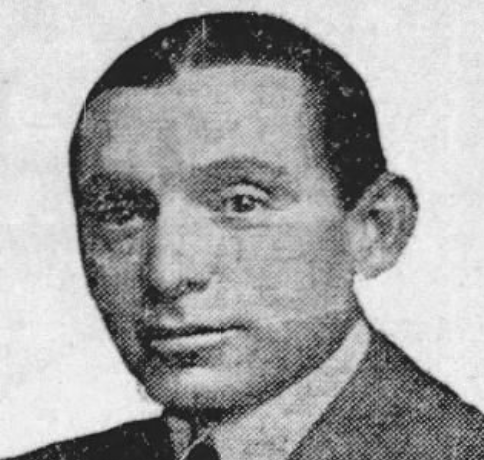
Ormond Butler lived a distinctly American life. Growing up in what would become West Virginia when he was eight, Butler moved to Baltimore, learned to play baseball, became an umpire and manager, all while converting into a theatrical agent and a stock broker. He knew Gentleman Jim Corbett, he worked for actor Edwin Booth, and traveled throughout most of the continental United States.
While not a player at the major league level, Ormond Hook Butler managed the Alleghenys of the American Association in 1883. He was the second manager the Alleghenys used that season – going 17-36 in the few months he had the reins. Butler had been an umpire in the Association when hired to replace Al Pratt. It didn’t take long for the Alleghenys to become disenchanted with the new manager. When the team played marginally worse than under Pratt, Butler was given his release and third baseman Joe Battin was put in charge of the players.
I mentioned that he was an umpire… Ormond appeared as an umpire in games for the American Association in both 1883 and 1886. However, he umpired other games which aren’t mentioned in the current record keeping. One was particularly notable. Here’s the tale from the Philadelphia Times (June 12, 1883: 1).

In later years, Ormond would tell stories about this incident, adding that one person in the mob had a gun, but he was unable to get close enough to Butler to get off a clean shot.
When not involved in baseball, he was an entertainment agent. Somewhere in the 1870s, Butler took interest in the theatre. Over time he would manage theatres such as the Grand Opera House in Pittsburgh, as well as performers and musicians. Among his clients were the New York Opera Company, the Rice Iolanthe Opera Company, actor Edwin Booth (the older brother of the infamous John Wilkes Booth) and, allegedly, Buffalo Bill… Butler once attempted to merge the two businesses, trying to open a theatre in Chicago that would receive wire notifications from baseball games and have actors recreate those onfield events on a rather large stage.
He’s the son of Ormond Butler, Sr. and the former Alcinda Hurdle, born in November, 1854. It’s not clear where Butler’s birthplace is, but Martinsburg, West Virginia claims him. According to the US Census records of 1860 and 1870, Ormond, Sr. worked in the railroad business, being listed as an engineer in the latter census record. Having moved to Baltimore, the younger Ormond was now working as an Iron Moulder as a teenager. According to folklore and Jefferson County history, Ormond, Sr. also ran hotels in Virginia and Maryland, including one at Harper’s Ferry. John Brown and his three sons stayed at his hotel before renting a nearby farm in preparation for their famous raid. When not running his hotels, Ormond, Sr. was briefly the acting sheriff of Charles Town, Virginia, which is where Brown’s trial was held. Somehow, a pistol belonging to Brown wound up in possession of relatives and, at least for a brief period, Ormond Hook Butler owned that pistol.
While he wasn’t a major league player, he was a competent outfielder for the Washington Nationals when it was an amateur franchise and when they were part of the National Association in 1879 and 1880, managing the team that last season. Pitcher Jack Lynch remembered a game where Butler raced back to the centerfield wall and leaped high over the fence to rob a player of a home run.
Butler also claimed that he helped Joe Corbett get his first major league pitching job with Washington in 1895. Heavyweight champion Jim Corbett was training to defend his title against Robert Fitzsimmons and Joe visited his brother’s training camp – which was property managed by Butler. When Jim told Butler about his kid brother’s skills, Butler reached out to Gus Schmelz, who gave Joe Corbett a tryout with his team.
In April, 1884, Butler married Fannie Steele Hodgen in Louisville. By 1900, Ormond was living alone as he took a room in Oxon, Maryland. After a detour into running a brokerage, he managed a theatre in nearby Washington, D.C. In 1907, they were separated by death when Fannie died. While a son was listed in Fannie Butler’s obituary in the Washington Times, no child is listed with any of the obituaries or articles that mentioned Ormond Butler’s death eight years later.
Ormond fell ill in late 1914 and, while he recovered some, he suffered a stroke which paralyzed him in the summer of 1915. He died in a sanitarium in Mount Hope, Maryland on September 12, 1915.
Notes:
Baseball-Reference.com
Retrosheet.org
1860, 1870, 1900 US Census
KY Marriage Licenses
Millard Kessler Bushong, “A History of Jefferson County, West Virginia,” Jefferson Publishing Company, Charles Town, West Virginia, 1941: 100.
“Local Brevities,” Scranton Republican, January 22, 1883: 3.
“Notes,” Cincinnati Enquirer, May 20, 1883: 11.
“A Beautiful Game,” Indianapolis News, June 22, 1883: 4.
“A New Manager for the Sluggers,” Cincinnati Enquirer, September 7, 1883: 2.
“The Sporting World,” Brooklyn Union, August 9, 1885: 12.
“Wings and Flies,” Buffalo Times, November 29, 1886: 5.
“Sparks from the Telegraph,” New York Sun, March 10, 1888: 2.
“A Broker Firm’s Trouble,” Washington Times, September 1, 1898: 10.
“Old Baseball Days,” Washington Nonpareil, December 26, 1901: 5.
“‘Ex-Senator’ Ormond Butler,” Washington Evening Star, April 21, 1904: 9.
“John Brown’s Pistol,” Martinsburg Herald, April 13, 1907: 7.
“Ormond Butler,” New York Times, September 15, 1915: 9.
Image Source: https://digital.library.louisville.edu/concern/images/ulpa_1980_020_0872?locale=en


 Mighty Casey Baseball
Leave a reply to John Thorn Cancel reply