BIRTH ANNOUNCEMENTS:
1858 Joe Straub
1862 Mac MacArthur
1865 Bill Anderson
1871 Abbie Johnson
1873 Arlie Pond
1874 Harry Atkinson
1874 Jake Boyd
1878 Jack White
1879 Jack McCallister
1885 Dolly Stark
1888 Pat Maloney
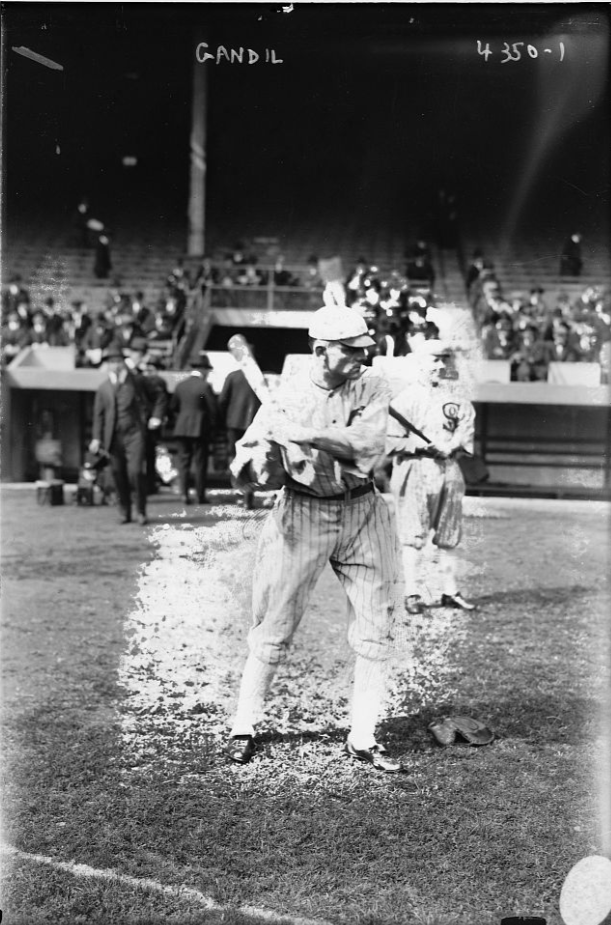
1888 Chick Gandil
Member of the Black Sox – in fact, he was among the ringleaders (if not THE ringleader). Gandil took home the most cash, used that money to hold out in 1920 and was out of organized baseball by the time he was banished forever. (He played in outlaw leagues, though.)
1895 Dan Boone
1896 Ollie Hanson
1903 Fred Lucas
1903 Merle (Lefty) Settlemire
1904 Jim Boyle
1906 Rip Radcliff
1910 Dib Williams
1910 Hugh Poland
1913 Andy Pilney
1913 Willie Hubert
1914 Benny Culp
1914 Al Piechota
1919 Ford Smith
1931 Ed Sadowski
1935 Fred (Squeaky) Valentine
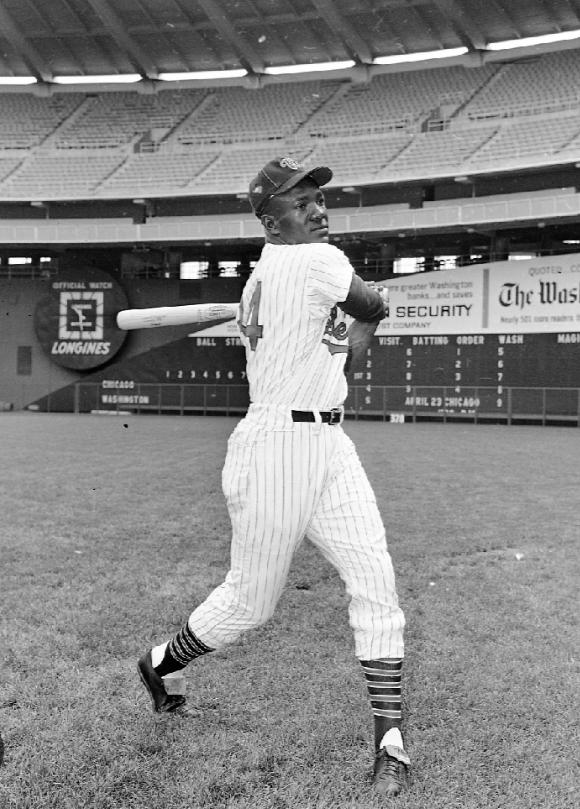
Fred Valentine was an outfielder with Baltimore and Washington in the 1960s – had a decent season in 1966, batting .276 with some power and 22 stolen bases, but didn’t maintain that level of production and disappeared after 1968. Of course, by the time Valentine got regular playing time, he was in his 30s – he was a victim of the racism of the period, which limited opportunities unless he hit like Willie or Hank.
Baltimore drafted Valentine as an infielder out of Tennessee A&I (now Tennessee State) having chosen baseball over football because there were no black quarterbacks in the NFL in the late 1950s. However, the Orioles had Brooks Robinson and Luis Aparicio – so he moved to the outfield.
Ted Leavengood wrote an excellent biography of Valentine for the Society of American Baseball Research – give it a read.
1948 Ken Frailing
Cubs/White Sox prospect that never really panned out.
1949 Ramon de los Santos
1950 Jon Matlack
Mets pitcher, and a good one, in the middle 1970s.
1954 Rich Gale
Royals starter (and, later, other teams) during the playoff runs in 1978 and 1980, won 14 games as a rookie, then 13 more in 1980. In 1978, despite going 14 – 8, walked 100 batters while striking out just 88…
1957 Brad Mills
1961 Ken Dowell
1962 Chris Sabo
Reds and Orioles third baseman – injuries clipped what started off as potentially a solid career.
1963 Scott Little
1964 Mark Grater
1964 Jim Morris
1965 Kevin Coffman
1966 Anthony Young

Owner of one of the longest losing streaks you might ever see – and yet he didn’t really deserve it. A pretty good pitcher on some awful teams running into awful luck.
1969 Orlando Palmeiro
1970 Rick Krivda
1970 Ricky Pickett
1971 Jeff Juden
1971 Phil Nevin
1973 Chris Stynes
1974 Amaury Telemaco
I saw Telemaco pitch while he was in Class A Daytona in 1994. He looked like he was going to be a dominating pitcher – reminded me of Joaquin Andujar with his presence on the mound. A couple of years later, he was with the Cubs and he bounced around the majors and minors for the better part of ten years. I rooted for him, but that apparently wasn’t helping.
1975 Fernando Seguignol
1975 Brian Mallette
1978 Wilton Veras
1979 Byung-Hyun Kim
1982 Terry Evans
1987 James Darnell
1988 Shawn Tolleson
1989 James Beresford
1992 Jharel Cotton
1993 Nick Burdi
1998 Brandon Eisert
2000 Travis Adams
OBITUARIES:
1900 Marty Bergen
Bergen was a catcher for Boston in the late 1890s, and a pretty good one. He also suffered from some form of mental illness, possibly schizophrenia or manic depression. Articles written at the time of his death talked about how he frequently left the team and suggested that he regularly felt like teammates were out to get him. Bergen even feared his family doctor was trying to kill him. His teammates and managers tolerated his moods because he was a great player – finally manager Frank Selee admitted that after the 1899 season he would eventually have to let his star catcher go. Bergen’s son died while on a road trip – and an already fragile mind became intolerably so. Bergen’s death was a complete tragedy – he used an axe to murder his wife and two remaining children then slit his own throat.
“Bergen Tragedy.” The Sporting News, 1/27/1900, Pg. 3.
1909 Dennis Casey
According to press reports of the day, Casey died at 4am in his Choconut Center (Binghampton, NY) home. The brother of Dan Casey was 50 when he passed. The Binghamton Press kept getting his middle initial wrong…
“Death of Well Known Ball Player,” Binghamton Press, January 19, 1909: 3.
“Many Regret Death of Dennis T. Casey,” Binghampton Press, January 20, 1909: 7.
1917 Charlie Enwright
Enwright was a victim of the medicine of his day. He had an abcess on his ear lanced; soon after an infection set in and the blood poisoning killed him.
Charles Massey Enwright was a Sacramento native, playing professionally there for three seasons before getting signed to play with the St. Louis Cardinals in 1909. He played in three games between April 19 and April 22, once as a pinch hitter and then twice at shortstop where he gathered one hit and two walks in his nine plate appearances. He even drove in and scored a run. Unfortunately he also made five errors (four in his first game in the field), which wasn’t going to serve him well with the Cardinals, so he went back to Sacramento and gave up the game altogether.
He joined his father’s plumbing firm (Miller and Enwright) in Sacramento, became active in civic and social affairs, and married the former Eleanor Wirthman before his passing at the age of 29.
“Charles M. Enwright Succumbs,” Sacramento Bee, January 19, 1917: 1.
1922 Bob Keating

Bob Keating makes your baseball encyclopedia and baseball-reference.com because on August 27, 1887, Keating pitched for Baltimore in the AA, a complete game loss at Cincinnati where he allowed sixteen runs (11 earned).
However, Robert M. Keating was far more than just a baseball player.
Keating invented one of the modern bicycles in the 1890s. Then, he advanced to creating motorcycles, and battery operated vehicles – essentially the same technologies used by modern cycles and electric vehicles today. He also came up with better chairs and at the time of his death was perfecting a silent flush valve. More importantly to this baseball site, he invented the modern rubber home plate.
Keating died after a short illness at his Springfield, Massachusetts home.
“Robert M. Keating, Bicycle Inventor and Maker, Dead,” Springfield Evening Union, January 20, 1922: 1.
1933 Con Starkel
1933 Harry Hinchman
1937 Tom Williams
1938 Wild Bill Everitt
Third baseman and first baseman with Chicago in the NL during the first century of baseball, was released for his lack of power and wound up in the new American League by joining Washington in 1901. Hit .376 in the Western League, earning a draft call from Chicago, then hit .358 as a rookie with the Colts. A collision while running the bases ruined his throwing shoulder – but Anson’s retirement after the 1897 season meant that Everitt could move to first base and his arm would be less of a problem. In 1898, he would set a major league record – most at bats by a first baseman without hitting a single homer. Hit .317 in his major league career before returning to the minors as both a player and later a manager. Owned his own grocery store and other businesses in his Denver home before being called to the great field in the sky.
(Summary adapted from David Nemec’s Major League Baseball Profiles, 1871 – 1900, Bison Books, 2011)
1957 Larry Strands
1957 Slim Branham
1960 Bob Fagan
1965 James Edwards
1972 Joe Goodrich
1973 John Williams
1976 Otto Ray
1977 Don Hendrickson
1978 Milt Shoffner
1987 George Selkirk
Nicknamed “Twinkletoes” by Ernest Lanigan because, as a Jersey City outfielder, he learned to run on his toes… Selkirk was the guy who replaced Babe Ruth in right field for the Yankees. He even wore his number. Obviously, Selkirk was no Babe Ruth, but he was a regular for much of the next six full seasons. He cleared .300 on five occasions, hitting between 11 and 21 homers in his full seasons, and twice driving in more than 100 runs. Selkirk’s career ended as World War II was taking players out of the majors. Even though Selkirk was Canadian, he served in the US Navy. Selkirk returned from the war and took up coaching and eventually moved into the front office. He was a player personnel director for Kansas City and Baltimore (at a time the Yankees made a lot of trades with both Kansas City and Baltimore…). In 1962, he became a general manager for the Washington Senators.
I see a future writing project for me…
1991 Roy Weatherly
1997 Bert Kuczynski
A brief summary of the two-sport star’s life can be found with his birth note here, as well as a link to his SABR bio. He was eleven days past his 77th birthday when Kuczynski moved to the next leagues.
2000 Manny Montejo
2000 Lynn Myers
2001 Johnny Babich
2003 Dutch Meyer
2004 Tommy Glaviano
2007 Bill LeFebvre
2013 Earl Weaver
Pitching, defense, and three-run homers. My friend, Becky Martorano, will tell you that the same attitude that Weaver took to baseball (and umpires) appeared when he would have dinners at Don Shula’s Steak House. She worked for Shula’s for many years and specifically remembers how few in the restaurant wanted to serve his table.
2013 Stan Musial
Not as exciting as Willie Mays but every bit as important to his team.
2013 Milt Bolling
When the two Hall of Famers passed away on the same day in 2013, few paid attention to the other guy who also died that day.
Milt Bolling was a southern born infielder mostly with the Red Sox during the 1950s. As his career wound down – he wasn’t much of a hitter – he got to play in the same infield as his brother, Frank, in Detroit. Milt’s career as a player ended, but for years he was an assistant to Tom Yawkey, and then an area scout based in his home of Mobile.
2016 Frank Sullivan
2016 Rich Severson
2017 Walt Streuli
2023 Bert Pena
I can’t find the source article, but my friend Sam Gazdziak of RIP Baseball wrote that Pena died of esophgeal cancer.
2024 Red Swanson
According to his obituary, Arthur Swanson was 87 when he died at his home. An LSU grad – but after he played professional baseball in the mid-1950s starting in his teens (looks like he was a bonus baby) – three seasons wasted with the Pirates when he could have been learning in the minors. Instead, he spent six years in the minors after he was a Pirate. To be fair, he wasn’t half bad with the Pirates in 1957; he went 3 – 3 as a swingman but could have used a little more control and a strikeout pitch.
He would coach at LSU, scout for a while, and became a petroleum landman.
2025 Jeff Torborg
YOU SHOULD HAVE BEEN THERE!!!
The most famous baseball related event was the Marty Bergen murder/suicide, noted above.
TRANSACTION WIRE:
1931 The PCL’s Oakland Oaks traded C Ernie Lombardi to Brooklyn for C Hank DeBerry and INF Eddie Moore. Lombardi would go on to have a Hall of Fame career.
1943 Boston releases Paul Waner. He wasn’t done, though – Waner signed with Brooklyn and even pinch hit ten times for the Yankees before he was done in 1945.
1961 Cleveland released Don Newcombe. He was done, sadly.
1983 Los Angeles trades Ron Cey to Chicago for Dan Cataline and Vance Lovelace. Cey would help Chicago win the 1984 NL East.
2004 Houston signs free agent Roger Clemens.
2007 Atlanta trades Adam LaRoche and Jamie Romak to Pittsburgh for Mike Gonzalez and Brent Lillibridge.
 Mighty Casey Baseball
Say, hello! Leave a comment!!!