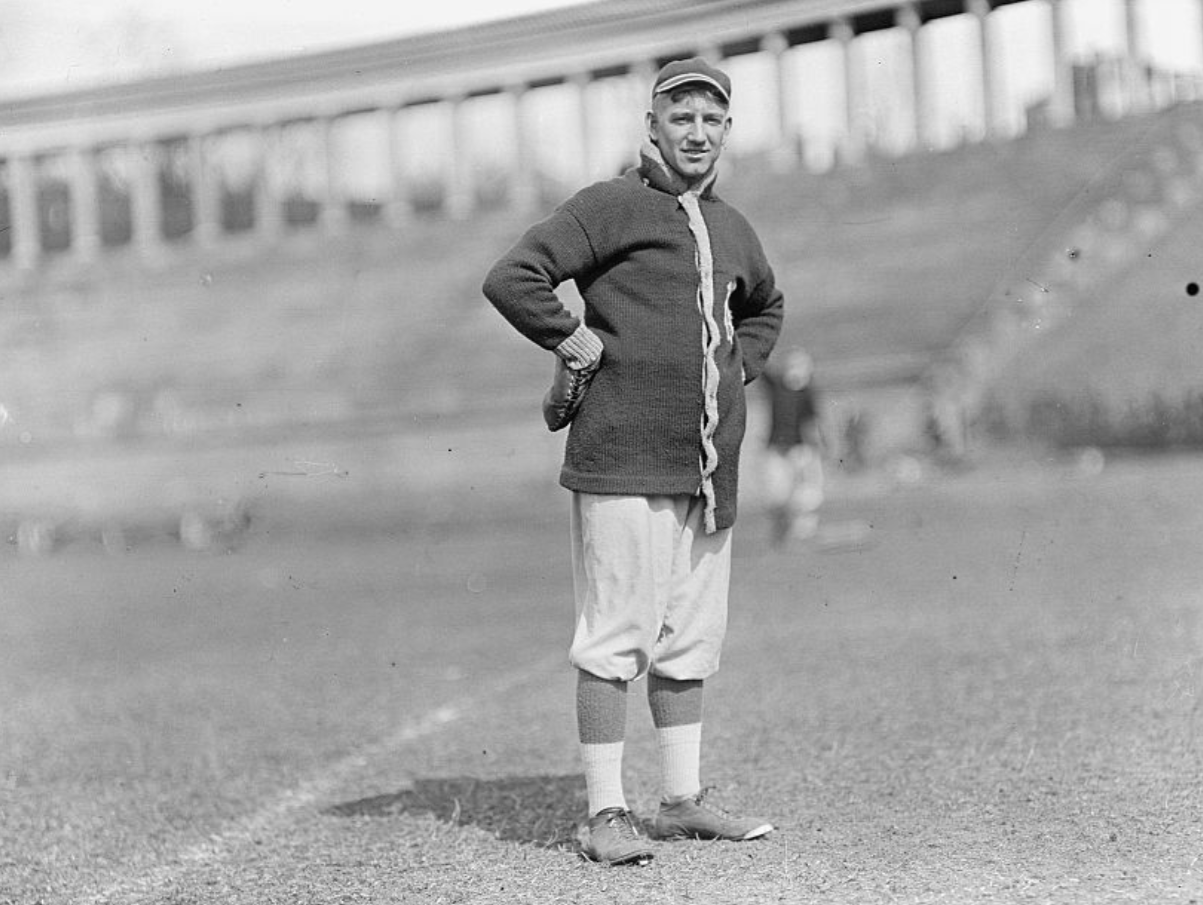
Joe Boehling’s career was marked by a long winning streak, a knee injury, and a motion to pick off runners at first base that apparently was unfairly deceptive according to umpires. (Think Andy Pettitte, without the help from umpires who should have been calling a lot more balks on him.) At his peak, the lean (5-11, 160) and strong lefty had a decent fastball and a sneaky change of pace.
John Joseph Boehling, Sr. was a Richmond native, one of at least seven children born on Church Hill to German imports Herman and Mary (Holzgrefe) Boehling on March 20, 1891. After attending the local parochial schools, he next attended Belmont Abbey Junior College in North Carolina, then returned to Richmond to attend McGuire’s University School. He actually began his collegiate career at Belmont Abbey as a left-handed shortstop and pitcher, something he did as an amateur. (He would play shortstop when not pitching because he was, at that level, still a good hitter. Boehling batted .212 with a lone homer in the big leagues.) In the three years he spent with McGuires, the baseball team only lost a single game.

The young pitcher was plucked out of the Richmond semi-pro leagues while with the Battle Axes Shoe Company in 1911. There are two stories that follow Boehling’s getting a tryout with the Senators in 1912. One has scout Mike Kehoe recommending Boehling to Washington owner Clark Griffith, and another suggests the sporting editor of a DC paper saw him pitch and sent a tip to Clark Griffith. Either way, Griffith liked what he saw when the Battle Axes came to DC to participate in a tournament featuring champions from Maryland, DC, and Virginia. Boehling had some minor league offers, but when Griffith came calling, he chose to sign with the Senators.
Griffith first sent Boehling to Chattanooga – who sent him back because of wildness. Griffith had Boehling pitch morning batting practice for a while, and then dispatched him to Worcester, where the kid was 14 – 8 in the New England League. Then Boehling, sometimes called “Dutch” because of his heritage and sometimes called “The Richmond Thunderbolt” when he was a young phenom, was brought back to the Senators to make five relief appearances in 1912. At the time, Boehling was considered a bit eccentric; among his odd behaviors was learning control by throwing stones at rabbits.
In 1913, he started his first full season with eleven straight victories – two in relief and then nine of them in starts – before he finally lost to the Browns in mid July. (If you are thinking that sounds like a record for most wins without a loss to start a major league career, it’s close. In 1904, Hooks Wiltse won 12 games to start his career, as did Butch Metzger from 1974 to 1976, according to research done in this blog post.) One highlight of the streak was striking out Ty Cobb with the bases loaded to stop a rally that allowed Boehling to win his ninth straight decision.
Still, the rookie finished 17 – 7 for 1931, and was 13 – 8 the next season. In early May, he injured his knee sliding into home in a game against the Athletics. Boehling kept pitching until early August, 1914 when Griffith suggested he rest to see if the knee would heal. However, in September Boehling went under the knife to deal with loose cartilege. The next spring, Boehling was courted by Federal League teams, but Griffith was unwilling to part with his young pitcher. However, before Clark Griffith would give Boehling his 1915 contract, Griffith asked to go for a ride in Boehling’s car. At some point along the way, the Senators owner asked Boehling to get out of the car – and then Griff had Boehling run six blocks or so alongside the car to prove his knee was okay. However, because the Federal League was threatening to sign Boehling away, Griffth ponied up a three year contract to his young pitcher.
Boehling had to change his throwing motion for 1915 – umpires said his motion was unfair to baserunners, leading to frequent balks (a record setting six in 1915). The change in his motion affected his control – according to John J. Ward, Boehling allowed “…more free passes than all the sporting editors of the country have issued in 13 years.” (In truth, he allowed 4.7 walks per nine that year. He was usually around 3.5 walks per nine. His strikeout rate, however, fell off a little bit, too.) Boehling’s record fell to 14-13 with a 4.12 ERA. For his career, Boehling finished at 2.97, so it was definitely an off year for him.
In mid-1916, the Indians took a chance at upgrading the team mid-season and sent outfielder Elmer Smith and infielder Joe Leonard to the Nationals for Boehling and outfielder Danny Moeller. Boehling, who had previous success against the two Sox clubs, failed to earn the necessary wins down the stretch and Cleveland faded to the second division in September. By 1917, poor performances and getting on the wrong side of the manager led to being sold to Toronto in the Eastern League, but the deal was never finalized.
He listed his employer as the Cleveland Indians when he filed with the draft board for World War I, but his baseball obit says he retired for two seasons before trying (unsuccessfully) to pitch for Cleveland in 1920. That’s probably not totally true but it’s somewhat true. He got married in February 1918, he was back on the Richmond Battle Axe semi-pro team again, and at some point he was called into service for the First World War. Given how late he was called into service, he likely never left Virginia. After a second semi-pro season, he gave pitching in the majors one more try, but he lost his only decision for Cleveland. He struggled with his control and his confidence.
Boehling was released by Cleveland as July, 1920 began; he signed with Oakland in the PCL where went 4-4, 2.94. In 1921, he split the summer between Toronto in the International League and Bridgeport in the Eastern League. Continuing his path down the minor league ladder, he signed with the Greenfield Blue Sox in July, 1922. After that, he was living in Richmond and pitching in semi-pro games and occasionally college old-timer games.
It was a good, if shortened, career. Boehling won 56 games against 50 losses. His 2.97 ERA over 925.1 innings was essentially league average for his era and he contributed to several teams that were in pennant contention.
After his career ended, he was well known in the city for stopping his car and helping some kid hone his delivery on some youth league mound. And he spent time coaching pitchers on the local American Legion squads. When not working or teaching kids to play ball, he was a hunter and a golfer.
Boehling and his brother, Frank, became merchants in the seed and feed business in Richmond after his playing days. (Frank also played semi-pro ball with Joe as young adults. Joe pitched to Frank, his catcher.) In 1918, Boehling married Gertrude Stumpf. They had a son, John Joseph, Jr., and a daughter, Marguerite. He died falling off his second story porch – must have been a heck of a fall as he crushed his ribs – at the age of 50 on September 8, 1941. He is buried near family in Holy Cross Cemetery in Richmond.
Notes:
Retrosheet.org
Baseball-Reference.com
1880, 1900, 1910, 1920, 1930, 1940 US Census Data
World War I Draft Registration
Virginia Marriage Records
Virginia Death Certificate
“White Sox Won,” The Free Lance (Fredericksburg, VA), August 21, 1909: 3.
William Peet, “Boehling, Crack Amateur Southpaw, Signed,” Washington Herald, January 9, 1912: 8.
“Joe Boehling,” Washington Herald, March 3, 1912: 14.
“Griffith Waiting For Answer From his Mullin Offer,” Washington Herald, June 18, 1912: 14.
“Boehling Gains Control By Most Unique Method,” Washington Herald, December 12, 1912: 12.
“Joe Boehling Adds One More Victory,” Washington Times, July 12, 1913, 10.
Sheridan, Hal. “Rise of Senators’ Southpaw Equals Mushroom Growth,” Canton Daily News, 9 August 1913: 6.
“Stanley T. Milliken, “Tinker After Johnson is Latest of ‘”‘Yarns’,” Washington Post, May 24, 1914: 49.
William Peet, “Boehling Holds Detroit Tigers,” Washington Herald, May 27, 1914: 10.
“Joe Boehling to be Operated on Monday,” Norfolk Ledger-Dispatch, September 26, 1914: 13.
“Joseph Boehling,” Sporting Life, 19 December 1914: 1.
John J. Ward, “Who’s Who on the Diamond,” Baseball Digest, 1917, Volume 19 Issue 5: 502-503, 531-532.
Ed Bang. “Cleveland in Critical Mood,” Sporting Life, 30 September 1916: 6.
“Joe Boehling Must Make Good With the Indians Next Year To Save His Salary,” Piqua (Ohio) Leader-Dispatch, December 16, 1916: 7.
“Joe Boehling Goes to Minors,” The Free Lance (Richmond, VA), 31 July 1917.
“Back With Amateurs,” Milwaukee Journal, June 11, 1918: 51.
“Boehling is Released,” Cleveland Plain Dealer, July 4, 1920: 20.
“Joe Boehling Joins Greenfield Blue Sox,” Norfolk Ledger-Dispatch, July 24, 1922: 14.
“Boehling Says Athletics Stimulant to Business,” Richmond Times-Dispatch, January 13, 1926: 8.
Charles Houston, “Left-Handed Shortstop,” Richmond Times-Dispatch, December 10, 1933: 24.
Tom Wiley, “Famous Athletes of Old Dominion,” Richmond Times-Dispatch, April 19, 1936: 22.
“Fall is Fatal to Boehling,” Richmond News Leader, September 8, 1941: 16.
“Necrology,” The Sporting News, 18 September 1941: 14.
 Mighty Casey Baseball
Say, hello! Leave a comment!!!