
I wrote this today (February 25, 2025) because until an hour ago, I thought Jim Britt was born on this date in 1856. Tinkering around, I learned that what we thought we knew about Jim Britt wasn’t accurate – but with the help of other SABR members who triple checked my essay (and came to similar conclusions separately from me) – we now have right Jim Britt connected to the right birth and death date.
When I first wrote this, Baseball-Reference.com didn’t list a birth or death date for James E. Britt. I got this date initially from the Lahman database years ago – so I thought I should try to confirm the birthdate.

In saying that, SABR showed his birthdate as February 25, 1856 and says he died February 28, 1923 in San Francisco. If the death date were correct that would make this James Britt the father of Jimmy Britt, a former lightweight boxing title contender. FindAGrave.com also shows these dates and links the ballplayer with the boxer. Except he’s not – the boxer’s dad was not a major league baseball player and left Brooklyn for San Francisco at 10 – so he wasn’t around to pitch in Brooklyn in 1872 or 1873. (See “Future Legislators,” San Francisco Examiner, October 30, 1886: 3.)
Wait – I should explain why Jim Britt is getting additional attention here (beyond discovering his biographical details)…
Jim Britt lost 64 of 90 decisions pitching for the Brooklyn Atlantics in 1872 and 1873. Britt pitched a lot in 1873 – 54 starts and 51 complete games… In five seasons Blake Snell faced 2448 batters from 2020 to 2024. Britt faced 2368 in 1873 alone. What makes Britt famous (or infamous, if true) is that he is associated with one of the earliest accusations of gambling affecting the outcome of a major league game.
When searching for stories about him, the first article I viewed noted that he signed his mail “James E. Britt.” The Brooklyn native and pitcher had written to the editors of the Brooklyn Review to defend himself against charges that he and others possibly threw a game against the Baltimores on July 22, 1873.
The accusation, as explained by a Brooklyn Eagle reporter was that Britt pitched relatively well in six of the innings he pitched – allowing a few hits and no runs. However, in the second inning, Britt allowed seven runs and it didn’t look like Britt was making the same level of effort in the inning. When his teammates got within a run to open the sixth inning, Britt eased up and allowed five runs in the bottom of the sixth. The Eagle wrote, “… the Atlantics pitcher afforded them easy chances, apparently, for some hits.” Also looking a bit fishy was that Britt’s teammate, catcher Tom Barlow, was allowed to bunt for six singles in that game (many because of the rule that allowed a ball that landed fair but rolled foul to still be considered in play).
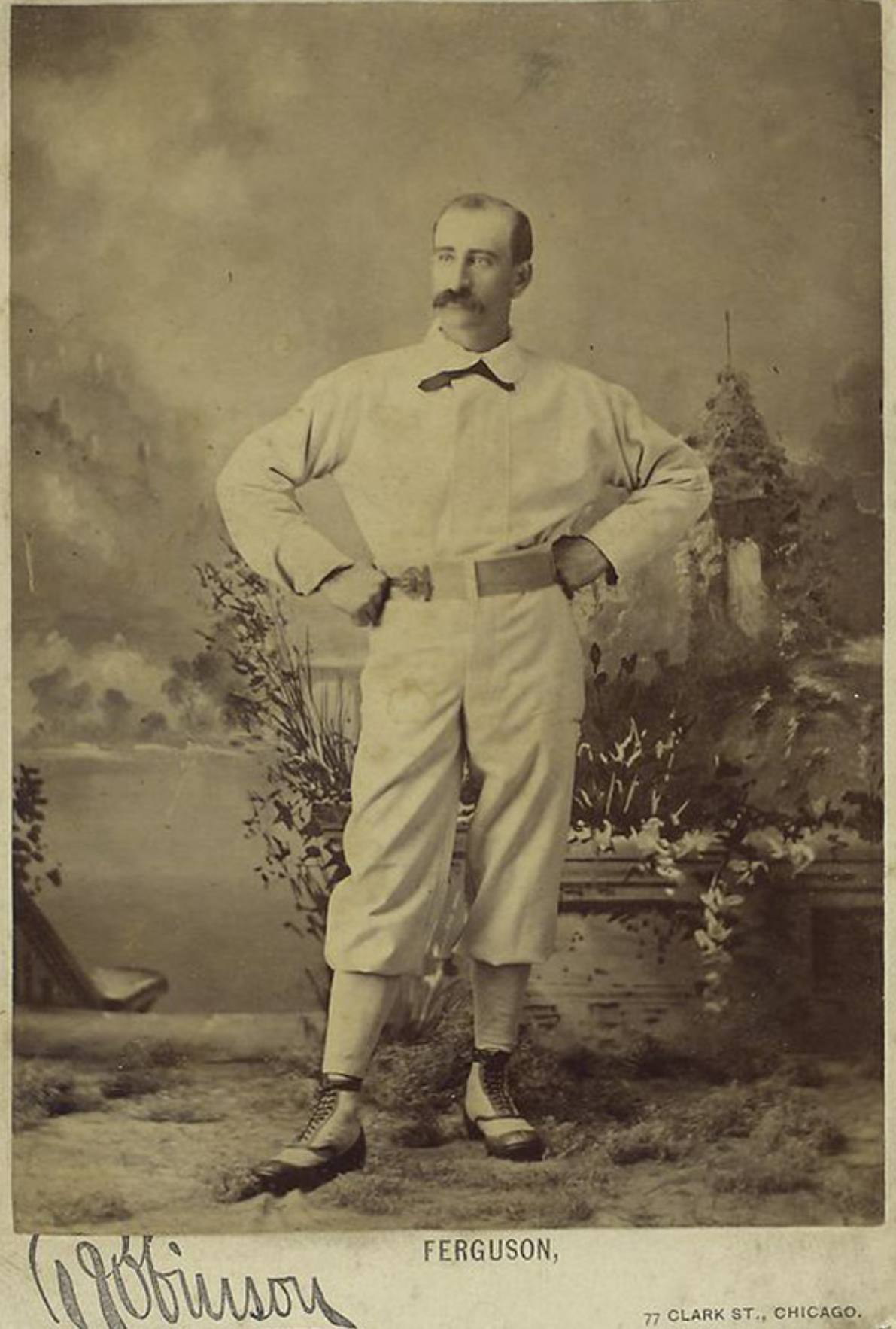
Anyway – the reporters weren’t the only ones who thought something was up. Apparently things had been brewing between gamblers at the Union Grounds and Atlantics team captain Bob Ferguson dating back to a July 4th game against the New York Mutuals. (Henry Chadwick said that gambling accusations were out in the open throughout July.) After the 12 – 9 loss to Baltimore Ferguson went into the stands, inserted himself into the center of a group of gamblers, and let them know he was ready to spill blood if needed to get them to stop buying his players.
This tirade was witnessed by a few reporters, and Ferguson’s outburst was not just printed in New York and Philadelphia papers, but picked up by other reporters (including Henry Chadwick). And, these articles named names – calling out Britt, Tom Barlow, and first baseman Herman Dehlman as the three players who received cash from gamblers to throw the game to Baltimore. And these players may have been targeted, in part, because of their ages. Both Barlow and Dehlman were 21; Britt had recently turned 24.
All three players sent cards to various newspapers claiming that the initial complaints in the Brooklyn Eagle were wrong (the quotes each player complained about came from other papers, however) and each said they would never throw a ballgame. A few days later, the Brooklyn Daily Times reported that claims against the three players could not be proven.
That said, Dehlman was suspended for one game (though the initial reports said he was to be replaced permanently by Herm Doescher). And the Brooklyn Eagle included betting lines in the coverage of a game against Washington later in the season. Soon after the dust settled in July, though, the Atlantics won four of five to get their record to 13 – 19. Unfortunately, that would be the high mark of the season. They would soon lose a dozen in a row and finish the season with 17 wins, 37 losses and a tie, the worst record among teams that played the complete season. Britt was hammered down that stretch, with the Atlantics allowing 218 runs during an 18 game stretch in September and October.
Britt’s baseball career resumed briefly as an amateur (he played for the Excelsiors). He alternated between working as a glass blower and taking a position as a clerk. Britt also served a couple of terms as an election clerk in Brooklyn.
It was his occasional political activity that allowed us to connect Jim Britt the baseball player to the correct James Britt in official public documents and events. To be fair, fellow SABR member Peter Morris came to a similar conclusion but wasn’t completely certain he was correct. Justin McKinney took some notes that I had (including a citation) and was able to show that Britt was a neighbor of a local politician using census records. Essentially Justin was able to confirm my conclusions and, because Peter had separately reached the same conclusion – SABR’s biological committee noted that we had solved a biographical mystery that had eluded baseball historians for about 140 years.
James Eugene Britt was born June 5, 1849 in Brooklyn to Irish imports Owen and Ann Britt. Owen was a laborer and Ann was busy raising five children. Owen died years before James made it to the big leagues; Ann took up doing laundry to help pay bills after his death.
In the early 1870s, James married Alice Gertrude Powers. They had a daughter, Margaret Ann, who was a toddler when visited by the New York census enumerator in 1875. They followed with a son, Eugene, in 1878.
Britt died of tuberculosis on August 21, 1882. His earthly remains were interred at Holy Cross Cemetery in Brooklyn two days later.
In October, 1882, Alice gave birth to a second daughter she named Alice. The father and daughter never met.
Notes:
1850, 1870, 1880, 1900 US Census
1855, 1865, 1875 New York Census
WWI Draft Registration Card (Eugene Britt)
NY Death Certificate
FindAGrave.com (includes Death Certificate details)
“Sports and Pastimes,” Brooklyn Eagle, July 23, 1873: 3.
“A Plucky Game of Ball,” New York Sun, July 23, 1873: 1.
“The Ball Field,” Brooklyn Eagle, July 25, 1873: 4.
“Sports and Pastimes,” Brooklyn Eagle, July 26, 1873: 4.
“Dishonest Players!,” Brooklyn Review, July 27, 1873: 1.
“All Right,” Brooklyn Daily Times, July 29, 1873: 3.
“Sports and Pastimes,” Brooklyn Eagle, July 31, 1873: 3.
“Pastimes,” Brooklyn Review, August 3, 1873: 1.
“Sports and Pastimes,” Brooklyn Eagle, September 4, 1873: 3.
“Base Ball,” Brooklyn Eagle, August 18, 1874: 3.
“The Clancy Excursion,” Brooklyn Eagle, August 20, 1874: 4.
“The Polls,” Brooklyn Eagle, October 30, 1878: 2.
“Died,” Brooklyn Eagle, August 21, 1882: 3.
“Died,” Brooklyn Eagle, August 22, 1882: 3.
 Mighty Casey Baseball
Say, hello! Leave a comment!!!