John Young Radcliff arrived June 29, 1848 in Philadelphia to John and Mary (Young) Radcliff – though an 1850 US Census record suggests he might have been born in 1846 instead. Father John was a Delaware-born trunkmaker who moved his family to Camden to start a business dealing in produce. Mother Mary worked at the family homestead raising five children. By 1870, this third child, John, would be working with his father; by 1880 it would be that child’s career.
Philadelphia was a great sports town after the Great War for Slavery and John Radcliff was a competent athlete. By 1867, he was the catcher on the professional Philadelphia Athletic Club, alongside Al Reach, Wes Fisler, Ed Cuthbert, Count Sensenderfer, and the other early stars of Philadelphia baseball. He remained with the Athletics, despite efforts made by Radcliff to find better paying clubs. In fact, while on a western baseball trip in 1868, Radcliff was working a deal to play for the Mutuals of New York. He was induced to stay in Philadelphia when his club raised $500 to help him pay off any obligations he may have had in trying to work his deal with New York. Radcliff may have kept some of that money for himself. And, while he was negotiating with New York, he was also trying to work a deal to join the Cincinnati club – the team that in 1869 would go on its historic undefeated season. When he signed to stay with the Athletic Club, he actually had a train ticket to go to Cincinnati in his pocket. In March of 1869, Radcliff was kicked out of the Athletic Club and rules and resolutions were created to address Radcliff’s “dishonest behavior.”

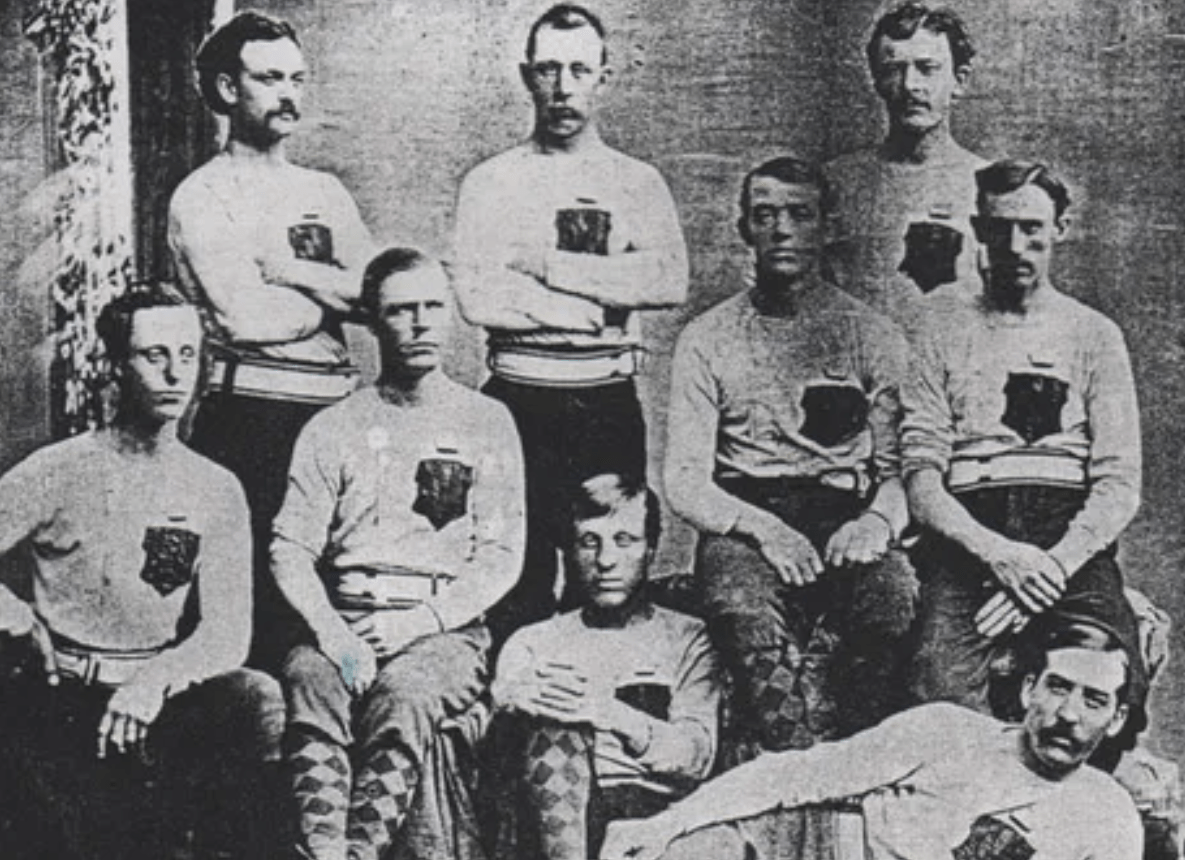
Despite this, Radcliff mended fences. In 1870 he moved to shortstop for the Athletics, though he occasionally would catch. When the National Association created the first professional “major league” in 1871, Radcliff played rather well on the pennant winning Philadelphia Athletic club, batting .303 with some power (though no home runs) and an above average On Base Percentage. A year later, he was with Baltimore where he would spend two years on competitive teams. The 1872 team photo is below – the rather intense looking guy seated in the middle, second from left, is Radcliff. You can’t see this in the image, but those jerseys were bright yellow, and those socks were loud for the era. The team fittingly was nicknamed the Canaries.
Radcliff returned to Philadelphia to join the Whites in 1874, though primarily playing in the outfield. In the summer of that season, Radcliff was accused of working with umpire William McLean to help throw a game to Chicago – claiming that his brother, Samuel, was placing a bet of $300 against his team and he had three other players who were helping throw the game. While a review of the incident left some doubt as to whether Radcliff was innocent or guilty, the decision came down as guilty and Radcliffe was expelled from the National Association (again). And, again, he was given another chance to play. In 1875, he signed to play for the Centennials of Philadelphia. Where once he was an infielder with a fairly good bat, he was now a poor hitting infielder on a team about to go out of business.
In a May 19, 1875 game against his former Philadelphia Whites team, he made three bad throws in succession to first base from his position at shortstop. “Had Radcliff played a good game, it is doubtful if the Philadelphia would have won at all, as the others did as well as was expected,” wrote a reporter for the Philadelphia Inquirer. At least nobody questioned whether the throws were purposely bad. The Centennials lost that game, 7 – 4. Five days later, the Centennials were out of business – and with that, Radcliff focused on the family poultry business.
John married Abraetta Munyan in Camden in 1879; they had four children. Hazel, Emma, and John, Jr., as well as Oslyn, who died in 1894 before her third birthday.
The Radcliffs were very successful in the poultry dealing business, amassing considerable family wealth. John would spend portions of his summers in Ocean City, NJ, occasionally making the social articles of local newspapers when visiting. John became a member of the Trimble Lodge of Masons and the Order of United American Mechanics. The latter group was known for advancing political positions to prevent American business owners from hiring new immigrants who could be paid far lower wages and to only do business with American companies.
Radcliffe died of a paralytic stroke on the morning of July 26, 1911. He had been out fishing with friends the day before while staying at a resort in Ocean City, NJ with his wife and three children. He was about to board a boat at the Ocean City yacht club when he pitched over and fell; this third stroke was considerably worse than previous episodes. When a physician reached the scene a few minutes later, he pronounced Radcliff dead. His remains were returned to Camden, where he was buried in Harleigh Cemetery.
Notes:
1850, 1870, 1900, 1910 US Census
NJ Marriage Index
NJ Death Index
Baseball-Reference.com
FindAGrave.com
William J. Ryczek. “Blackguards and Red Stockings” (Kindle Version), McFarland, 2016.
To note, Ryczek’s book is great. I skimmed around for Radcliff in the book, finding his discussion of the 1874 gambling scandal. From there, I went and hit the newspapers and found two articles that listed specific details that are cited below. I wouldn’t have looked for them were it not for this book.
“Our Invincibles,” Philadelphia Inquirer, August 21, 1867: 1.
“The Athletic Base Ball Club – A Match,” Philadelphia Inquirer, May 11, 1868: 2.
“Sports and Pastimes,” Brooklyn Union, March 10, 1869: 1.
“The Athletic Club vs. John Radcliff, Jr.,” New York Clipper, March 20, 1869.
“Base Ball,” Philadelphia Inquirer, November 11, 1870: 3.
“Sporting News,” Chicago Tribune, September 2, 1874: 8.
“Base Ball,” Philadelphia Inquirer, September 9, 1874: 2.
“The Base Ball Field,” Philadelphia Times, May 20, 1875: 4.
“John Radcliff Dies Suddenly,” Camden Daily Courier, July 26, 1911: 11.
“Former Ball Player Dead,” Asbury Park Press, July 27, 1911: 2.
Frank Fitzpatrick, “Ghosts of Summer,” Philadelphia Inquirer, October 27, 2013: E2. (1872 Canaries image from here, as well as suggestions to look harder for Radcliff stories during the 1870s.)

 Mighty Casey Baseball
Say, hello! Leave a comment!!!