BIRTH ANNOUNCEMENTS:
1849 George Hall
A forgotten star, for sure, but for a very good reason… Hall’s career started with amateur and quasi professional teams in the 1860s into the 1870s, including driving in the winning run to stop the Cincinnat Red Legs undefeated streak in 1870. Hall’s MLB career starts with the National Association and continued into the first years of the National League where he hit .332 with a fair amount of power. Modern stats suggest his hitting was 40% (!) better than the average hitter. Hall was a fine outfielder – when he played in his final season for Louisville, there was no sign that he couldn’t play anymore. He led the league in games played, hit what he usually hit – a very good player.
Anyway – like a bunch of these players, he moved around from year to year based on what kind of offer he could get and the changing status of teams in what was a fluid period for professional baseball. He was with the Olympics of DC, then Baltimore for two seasons, spent a year with Boston, moved to the Athletics for a couple of years before landing in Louisville. The Olympics, for example, decided they weren’t going to be professional. Baltimore folded. When Philadelphia chose not to finish the NL schedule, they were booted.
So why did Hall leave Louisville? Because he helped throw a bunch of games, costing Louisville a pennant and Hall his career. So, yeah, he was a cheater. Which is why he is a forgotten star.
Matt Albertson wrote Hall’s bio for SABR, which is (along with Nemec’s work) the source for this quick summary.
1855 Bill Harbridge
1858 Gus Shallix
1865 Hank Gastright
1866 George Carman
1867 Cy Young
1867 Toby Lyons
Lyons made a few starts for Syracuse in 1890, but his talents were better served on the vaudeville stage.
1873 Duff Cooley
1875 Barney McFadden
1876 Harry Lochhead
1876 Frank Oberlin
1881 Lou Schiappacasse
1883 Rube Dessau
1888 Lee Meyer
1889 Georeg (Squanto) Wilson
1892 Harry McCluskey
1894 Dixie Leverett
1894 Alex McColl
1894 Bob Steele
1899 Herb McQuaid
1900 Red Schillings
1908 Gibby Brack
1908 Bill Strickland
1910 Bill Dietrich
1915 Johnny Gorsica
1917 Tommy Holmes
1918 Allen Bryant
1921 Ferris Fain
1944 Denny McLain
What a fall, huh? Ace of the Tigers, winning 31 games in 1968. Three years later, he’s unable to win games for the Senators. He was gone. And he was then in prison.
Like Roger Maris, is famous for one season, but actually won TWO awards. McClain won the Cy Young award in 1969, too.
1952 Bill Castro
1953 Tom Hume
1954 Mike Ramsey
1954 Tom Tellmann
1955 Karl Pagel
Looked like a prospect for the Cubs in the 1970s but it never worked out. He played a couple of years in Chicago and a few more in Cleveland. Pagel had four legit great seasons in the minors and I wonder if Pagel thinks that was just horribly unfortunate that the teams that had him didn’t give him full chances to prove that talent.
If you ever go back and look at his minor league numbers, you KNOW he’d have a shot in the 2020s. Power, walks, a few too many strikeouts. At a minimum he’s a DH and 5th outfielder or 1B.
1958 Domingo Ramos
1961 Mike Kingery
1962 Billy Beane
1966 Eric Gunderson
1967 Brian Jordan
1967 Geronimo Pena
1968 Juan Bell
1971 Sean Lowe
1972 Alex Ochoa
1975 Danny Kolb
1975 Marcus Jones
1976 Scott Atchison
1976 Kevin Nicholson
1978 Eric Bruntlett
1984 Kila Ka’aihue
1991 Pat Light
1992 Chad Pinder
1994 Matt Olson
1999 Jose Fermin
OBITUARIES:
1892 Adam Rocap
1898 Tony Hellman
1907 Doug Crothers
1907 Cozy Dolan
1908 Forrest Crawford

Forrest A. Crawford was a shortstop out of Texas who got a long look with the St. Louis Cardinals in 1906 and a shorter one in 1907 before being released to Providence. He had flourished in the Texas Leagues prior to this and remained remarkably popular in his adopted Austin, Texas home.
Crawford started the process of getting into baseball shape for the 1908 season, but in the beginning of March he struggled to exercise without pain. The pain in his side came from lesions in his hip. He had injured his pelvic bone as a child when he fell down an elevator shaft. For most of 20 years the hip didn’t bother Crawford, but suddenly he was in worse condition and his health worsened with each passing day. Ed Karger, his teammate in both Houston and St. Louis called on him, leaving spring training to visit with his good friend.
As a last resort, doctors tried surgery. It didn’t help, however, and Crawford died of heart failure caused by blood poisoning soon after the operation concluded in the Seton Infirmary in Austin, TX. Crawford’s remains lie in an umarked grave near family members in Oakwood Cemetery in Austin. His wife, May, moved to Houston to be near her family but died just three years later and is buried next to her husband.
As an aside, Baseball-Reference lists his birthdate as May 10, 1881, which is corroborated by the 1900 US Census which says he was born in May, 1881. However, if you use Crawford’s death certificate (which tells you how many years, months and days old he was when he died), it suggests his birthday was April 19, 1881. Either way, Crawford was three or six weeks shy of his 27th birthday when he passed to the next league.
1933 Ed Watkins
1933 Harry Salisbury
1937 Bill White
1945 Ray Tift
1945 Jim Hughey
1958 Jimmy Archer
1959 Johnny Allen
1960 Kid Carsey
1962 Otto Miller
1963 Wilcy Moore
1966 Ted Walters
1968 Buddy Napier
1971 Gus Salve
1975 Oscar Fuhr
1979 Luke Easter
1984 Hugh Poland
1988 Ted Kluszewski
1990 Phil Masi
1994 Ray Bare
1995 Terry Moore
1998 Dick Phillips
2000 Hank Miklos
2004 Al Cuccinello
2006 Thornton Kipper
2012 Ray Narleski
2018 Rusty Staub
2018 Ed Samcoff
2018 Jim Holt
2024 Wayne Schurr
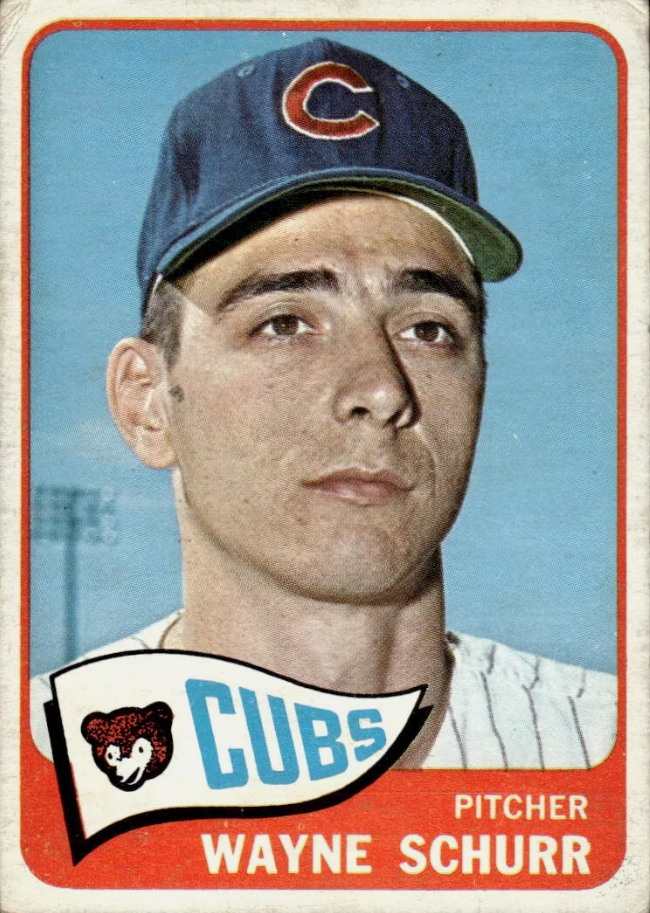
Schurr was a pitcher with the Cubs in 1964. I recognized his name because one of the odd elements of my baseball card collection is that I have pretty much every 1965 Cubs baseball card and Schurr was in that set.
Anyway – Schurr threw a no hitter in the minors, he wasn’t altogether an unsuccessful pitcher in the majors (given the teams he played on and the park in which he pitched). That said, Schurr was left with no decisions in 26 appearances. He left baseball and worked for Magnavox for three decades, married twice (he outlived his first wife) and a son gave him grandchildren. He died at 86 due to complications associated with being 86 and having Alzheimer’s (inferring this from the donation request in his obit). It was a good run…
YOU SHOULD HAVE BEEN THERE!!!
1954 Cubs manager Phil Cavaretta is fired for speaking the truth – he felt the team would not finish in the first division. He becomes the first manager to get fired during spring training.
TRANSACTION WIRE:
1899 Now that one guy owns both the St. Louis Perfectos (the Cards) and the Cleveland Spiders, all the good players are moved from the Spiders to the Browns. The decimated Spiders would go on to win just 20 of 154 decisions that season before being contracted and removed from the league.
1977 Toronto sends outfielder John Lowenstein to the Indians for Hector Torres.
1978 The Cubs acquire Rodney Scott from Oakland for Pete Broberg.
 Mighty Casey Baseball
Say, hello! Leave a comment!!!