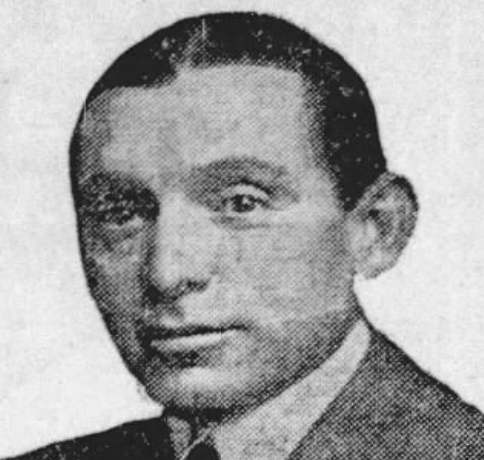
Toby Lyons is worthy of a full bio, but not because of his baseball career per se. Lyons is here, of course, because he made three starts for Syracuse in 1890 when there were three major leagues and more opportunities for a player to get a shot at a professional paycheck. He lost two of three starts and was swatted around enough to know he would be better served plying his trade on a different stage. (Certainly his manager knew that – he released him after three starts.)
Lyons’ second pursuit? Comedy. Toby hit the vaudeville stages, mostly in comedic roles, and continued on the stage for nearly three decades – including at least five shows on Broadway – until his death August 27, 1920.
Thomas Arthur Lyons was the last of six children, arriving March 29, 1867 in Cambridge, Massachusetts to Jeremiah and Mary (Lynch) Lyons, a pair of Irish immigrants who came to the US during the great English potato thievery era. Jeremiah was an enterprising man, building some wealth as a liquor distributor and restauranteur in the Boston area while Mary was equally busy raising a large family, albeit with the help of a domestic servant.
The Lyons children were all educated locally through at least high school. Lyons began playing ball as a kid, what with Boston being one of the great baseball cities in the years after the Great War for Slavery. He played on local town teams before joining a team in his second home of Somerville, Massachusetts. By 1886, known as Toby and not Thomas or Tom, Lyons was brought in to pitch for Rockland. Over the next few seasons, he pitched for teams in Salem, Rochester, and Nashua.
…Lyons, a pitcher, who played on the Rocklands last year, and won nearly every game he pitched, later played with the Rochesters and was very successful. He gives promise of much ability.”
“Base Ball,” Portland Evening Express, May 21, 1888: 4.
In the summer of 1888, he joined one of the top semi-professional teams, becoming captain of the John P. Lovell Arms Company team where he earned a fair reputation as a solid pitcher and occasional outfielder. The Boston Globe noted Lyons, “…fielded his position well, and proved himself to be quite a base runner…” In the offseason Lyons earned a job at Bowdoin College in Brunswick, Maine, where he coached and trained players in advance of the college baseball season.
In 1890, he was courted by the Syracuse Stars, who were now members of the American Association. Previously a championship level team in the high minor leagues, Syracuse manager George K. Frazer found backing from local businesses and tried to compete at the highest levels of baseball. The team already consisted of major leaguers like Mox McQuery, Cupid Childs, Bones Ely and Dan Casey and looked to add other young talent.
Frazer signed Lyons to pitch and forwarded $50 as an advance. Lyons held out, claiming Frazer offered to forward a full month’s salary as an advance. Eventually, Lyons relented (the Rochester Democrat and Chronicle wrote,” After all his kicking, Pitcher Toby Lyons has reported to the Syracuse club…”) and joined the team, but he had missed a good chunk of the spring training held in Louisville. Put in to start the second game of the season, Lyons lost to Brooklyn 22 – 21. Frazer gave Lyons a second start, which he lost 11 – 10 to Philadelphia. He was relieved in his third start, a home win over Brooklyn – but didn’t get that decision. Frazer saw all he needed to see – 36 runs allowed in 22.1 innings and only 6 strikeouts against 21 walks – and sent Lyons home.
Lyons allegedly had interest from Brooklyn but instead returned to the Lovells. He frequently posted a willingness to pitch professionally in the Boston Globe – with no success. His career wasn’t necessarily memorable – and yet, he did leave behind a few nuggets that suggested he was an interesting man on the mound. A. G. Doe remembered that Lyons was a quirky and entertaining lefthanded pitcher who used to give names to pitches that were successful – until that pitch got crushed. Then, he would change the name of the pitch. His fastball was frequently called “Old Syracuse” – and Doe recalled, “One of our players hit ‘Old Syracuse’ up against the fence and put the game on ice for us. When asked if it was ‘Old Syracuse,’ he said, “No, it is my ‘Wollaston Disaster’ ball…”
For much of the 1890s, Lyons worked as an arbiter, umpiring some college games for Harvard as well as hundreds of games in the New England Association. As with all umpires, there were days he was less appreciated.
“An excellent example of this is the telegram sent by Manager McDermott to the secretary that he would forfeit yesterday’s game rather than play under Umpire Lyons…”
“Give us a Decent Schedule,” Fall River (MA) Evening News, July 26, 1893: 1.
However, his personality and greater experience won him some fans.
“Always a comedian, he had a happy faculty of getting through a contest without any trouble, and there was always more or less fun when he was in charge.”
“Amusements,” New Bedford (MA) Evening Standard, March 28, 1901: 10.
He also refereed polo matches during that time.
However, during that decade, the number of articles including Toby Lyons on the sports page grew smaller as the number of articles about Toby Lyons on the amusements pages grew larger. In late 1891, sports fans would see this article in the Boston Globe.
“The overflowing house at the Howard last night was attracted by the Night Owls Beauty show, and from the fact that two Bostonians were to make their debut.
“The young men were the two well-known ball players, Toby Lyons, the pitcher, and young Daly of Cambridge, who had resolved to emulate the example set by Mike Kelly and Arlie Latham.
“Very few of their friends who went there with the kindliest of feelings imaginable were prepared for the signal success achieved by the young men. Both have good voices, a fair stage presence, and do their work cleanly and well.”
“Howard Athenaeum,” Boston Globe, October 27, 1891: 3.
Following the path of his older brother Daniel, who was listed as an actor in the 1880 US Census, Toby Lyons put his comedic talents in front of the paying patrons of Boston stages. He would join a number of vaudeville reviews, sometimes performing alone and other times with partners or dancers. Lyons would sing parodies of news events or mimic more famous people. In time, Lyons would perform on bigger and bigger stages with more famous stars.
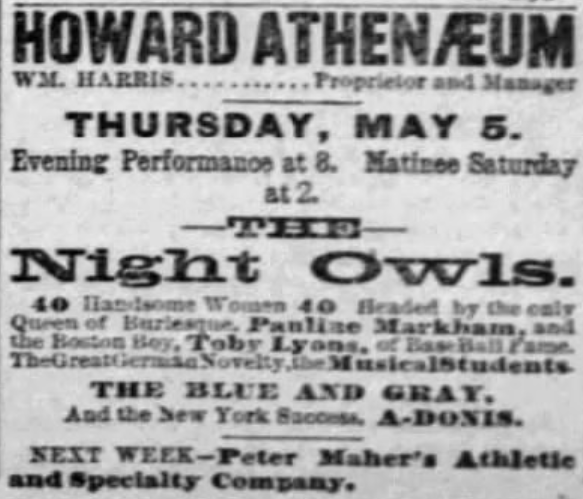
In 1892, he was performing at the Howard Athenaeum with the Queen of Burlesque, Pauline Markham. When baseball star Mike “King” Kelly took to the stage, he considered pairing with Lyons in the Barney Lennon written sketch called “The Never Strike Out.” In 1894, he appeared at the Columbia Theatre in a benefit show tendered for Louis Burhhardt. Lyons starred alongside actress Helen Dauvray, who doubled as the wife of John Montgomery Ward.
In 1895, he appeared with comedian Ned Buslin in a burlesque tragedy called “The Fatal Wedding” at the Grand Museum in Boston.
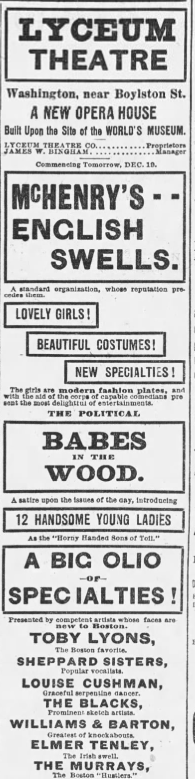
In his comedic life, however, not every day was laughs. There would be times where he was not working stages from Boston to Chicago and throughout New York. In 1892, he was horsing around with friends and wound up sparring some with an older gentleman named James Shattuck. Lyons’ friend, Ernest Flagg kicked Shattuck during the fray. Shattuck decided he had had enough – and then died the next day. Then, in 1897, another article that landed in various Massachusetts papers included the following note:
“Officer Curtis barely prevented Toby Lyons of Boston, a well-known baseball player and actor, from throwing himself from the roof of a five-story building. Lyons was suffering from an attack of delirium tremens.”
“Crimes and Casualties,” Fitchburg Sentinel, March 31, 1897: 5.
However, his acting fortunes took a turn for the better with the arrival of the 20th century. Beginning in 1900, he found successful pairings with Tony Williams and, later, Tom Crowley. The partnership with Crowley would last a few years and give each major career boosts. Then, Lyons stumbled on a song idea he called “Hinkey Dee” – a rolling parody song that would regularly change verses based on current events and local news. Within months, Lyons surmised he had written at least 76 different verses, with four new ones ready to be swapped into the routine. Lyons performed his “Hinkey Dee” song for the rest of his career.
(I can’t help but think of Jimmy Durante, whose song “Inky Dinky Doo” has the vibe of Lyons’ “Hinkey Dee.” I’m not saying Durante borrowed from Lyons directly, but that the stylings would be similar – and Durante’s career began in 1910, which was ten years into Lyons’ use of the “Hinkey Dee” routine – and would continue another ten years forward.)
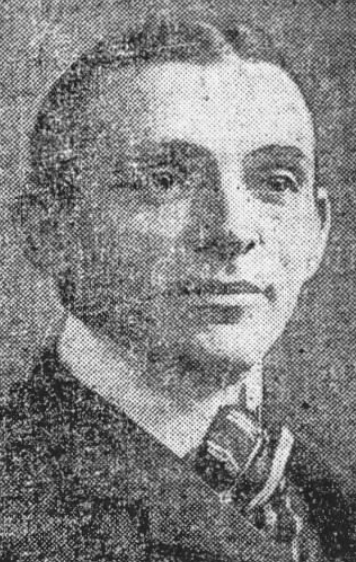
In 1904, Lyons landed a major role in the Allen Lowe/Paul Schindler romp “The Isle of Spice” at the Globe Theatre. From there, Lyons rolled through several successful Boston productions, including “Kafoozelum”, “The Geezer of Geck”, “Yankee Regent”, “What Wright Left”, and “The Press Agent.” This propelled Lyons into even greater opportunities, including the bright lights of Broadway. According to the Internet Broadway Database (IBDB.com), he appeared on Broadway stages in five different shows, including “The Street Singer” at the American Theatre in 1904, “The Mills of the Gods” at the Astor Theatre in 1907, “The Boy and the Girl” at the Aerial Gardens in 1909, “In Hayti” at the Circle Theatre in 1909, and finally “The Honeymoon Express” at the Winter Garden Theatre in 1913.
The bulk of his career and life, however, were spent in the Boston area. In 1895, Lyons married Eliza Julia Scott (formerly Mealey, but she legally changed her name the prior year). The showman married a hotel proprietress. Their relationship did not produce children.
Lyons died August 27, 1920 in the Allston neighborhood of Boston, Massachusetts and is buried in Holy Cross Cemetery in Malden. He was 53 years old at the time of his passing.
Sources:
1870, 1880 US Census Data
Massachusetts Roman Catholic Church Dioceses Records
Massachusetts Marriage Data
Image Source: Boston Globe, August 27, 1920: 4.
Image Source 2: Boston Globe, June 5, 1904: 23.
“Diamond Points,” Boston Globe, June 13, 1887: 5.
“Rochesters, 10; Dovers, 6,” Boston Globe, August 20, 1887: 5.
“Rochester Briefs,” Boston Globe, September 5, 1887: 8.
“Base Ball,” Portland Evening Express, May 21, 1888: 4.
“Nashua, 6; Dover, 4,” Boston Globe, July 7, 1888: 5.
“Toby Lyons’ Thanks for the Watch,” Boston Globe, May 6, 1889: 3.
“Pleased with Toby Lyons,” Boston Globe, September 1, 1889: 5.
“Toby Lyons’ Coaching,” Boston Globe, February 9, 1890: 6.
“Pickups,” Rochester Democrat and Chronicle, March 27, 1890: 7.
“Pickups,” Rochester Democrat and Chronicle, April 6, 1890: 7.
“Little ‘Tips’ Caught on a ‘Fly’ in the Professional World,” Buffalo Post, May 20, 1890: 10.
“The Association,” Rome (NY) Daily Sentinel, April 3, 1890: 4.
“Ball Gossip,” Boston Globe, May 20, 1890: 6.
“Amateur Notes,” Boston Globe, August 22, 1891: 3.
“Howard Athenaeum,” Boston Globe, October 27, 1891: 3.
“Sporting Events,” The Daily Item (Lynn, MA), January 14, 1892: 8.
“Base Ball Notes,” Boston Globe, May 20, 1892: 3.
Advertisement, Boston Globe, May 5, 1892: 3.
“Gloucester, 11; Ipswich, 6,” Boston Globe, July 17, 1892: 4.
Advertisement, Boston Globe, October 16, 1892: 10.
“Held for Death of Friend,” Boston Globe, August 2, 1892: 10.
“Base Ball Notes,” Boston Globe, October 15, 1892: 3.
Advertisement: Boston Globe, December 18, 1892: 10.
“Give us a Decent Schedule,” Fall River (MA) Evening News, July 26, 1893: 1.
“Robinson’s Musee Theater,” Buffalo Courier, January 17, 1893: 5.
“The Eden Musee,” Holyoke Transcript, April 25, 1893: 4.
“Grand Museum,” Boston Globe, February 3, 1895: 18.
“Crimes and Casualties,” Fitchburg Sentinel, March 31, 1897: 5.
“Even Break at Worcester,” Rochester Democrat and Chronicle, September 10, 1899: 18.
“Foyer and Greenroom Gossip,” Boston Globe, June 10, 1900: 18.
“Music Hall Vaudeville,” Boston Globe, November 18, 1900: 18.
“Amusements,” New Bedford (MA) Evening Standard, March 28, 1901: 10.
“Howard Atheneum,” Boston Globe, April 12, 1903: 33.
“Howard Atheneum,” Boston Globe, March 24, 1903: 8.
“Plays and Players,” Boston Globe, April 26, 1903: 33, 34.
“Music and Drama,” Boston Evening Transcript, May 7, 1904: 16.
“The Isle of Spice,” Boston Globe, May 10, 1904: 8.
A. G. Doe, “Great Lefthanders Furnish Real Sport,” Sunday Standard, August 10, 1919: 13, 15.
“Thos. A. Lyons Dead at his Boston Home,” Boston Globe, August 28, 1820: 3.
 Mighty Casey Baseball
Say, hello! Leave a comment!!!