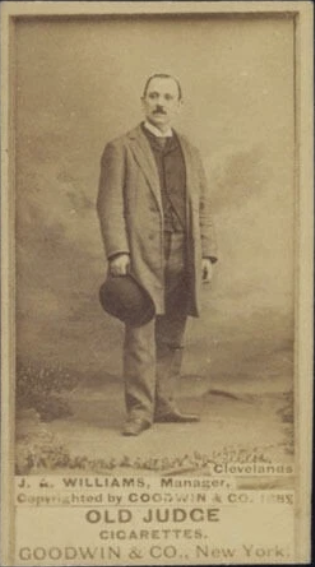
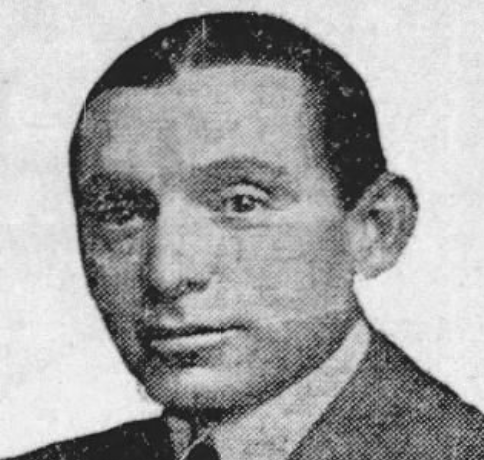
Jimmie Williams is here because he is listed as the manager of a few teams in the 1880s. In all fairness, he was more of a business manager and not necessarily a field manager (though he had a good knowledge of baseball strategy through his long association with the game). That said, J. A. Williams is rightfully the father of baseball in Columbus, Ohio.
James Arthur Williams arrived in Catawba, Ohio to Dr. James Williams and Mary Margaretta Staley January 4, 1847. He was the second child (and first son) born to the couple. Sadly, Mary wouldn’t enjoy her children long – she died three weeks after giving birth to James Arthur. Dr. Williams married a second time – wedding Sarah Staley, Mary’s sister, and they had five more children. At least for some period of time, the younger James lived with his mother’s parents in Mechanicsburg while his father worked throughout the state in various roles.
Dr. Williams came to Columbus as a doctor and surgeon, but he earned greater notoriety as an active politician and member of the Whig and, later, Republican parties. Dr. Williams served in the state house for a number of years and even participated in the nomination process of Abraham Lincoln for the presidency in 1860. He eventually took a position as a state auditor in Columbus until his retirement. A biographical note suggested that Dr. Williams retired in poorer circumstances than he might have. He was unwilling to take advantage of his political roles to gain greater wealth and even refused to collect his military pension for services provided during the Great War for Slavery.
However, his positions did provide opportunities for his eldest son. James – known colloquially as Jimmie – was given clerk roles for military offices in Columbus and was hired as one of five congressional pages for the Ohio State House of Representatives. There, Jimmie earned $2 per day (even the reps only earned $3 per day) and took on a wide variety of tasks. “We had everything to do then; everything from scrubbing out the cuspidors to advising with the legislators on various matters of policy,” Williams remembered some forty years later at a reunion of the five former pages in 1904. He graduated from page to a clerk in his father’s office by 1866.
When the war ended, Columbus became one of the many western cities that took up the eastern city sport of baseball. The first organized baseball club was created in 1866 and James was made president of that club – and the second baseman. His younger brother Elwood also played, lining up at third base. The first official game was played on April 6, 1866 on Sam Bartlett’s lot near East Broad Street, which later became the home of the Douglass Street School Building. Many of Columbus’s prominent gentlemen appeared in that game. The two teams didn’t take names – the winning side scored 95 runs in a full nine inning, four-hour game. The Williams brothers were member of the losing nine which scored 44 runs.
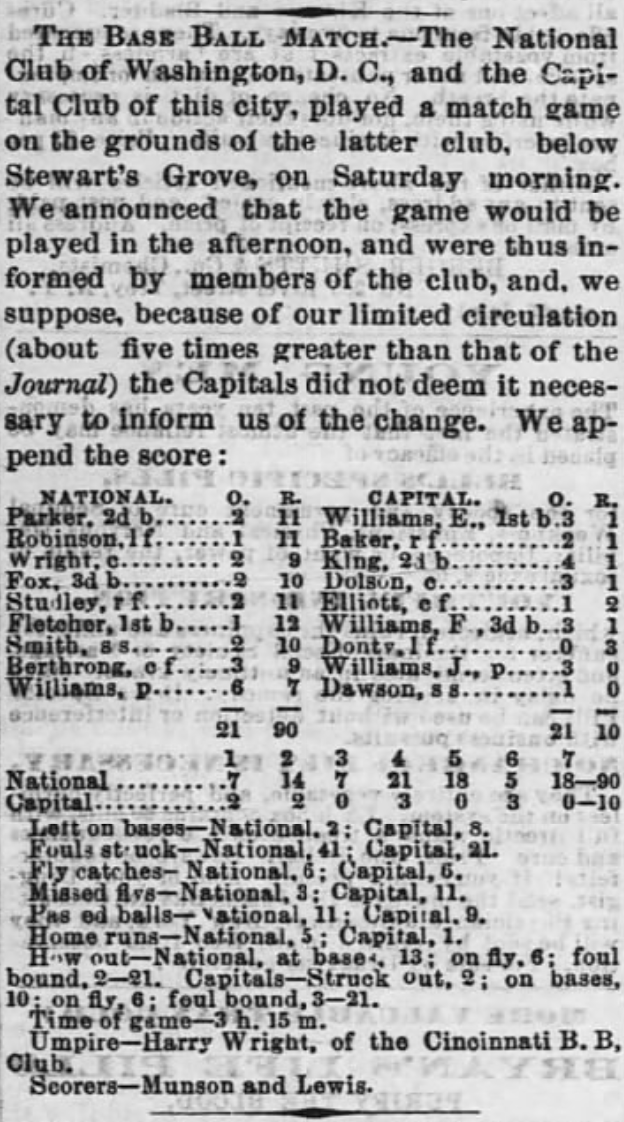
A year later, when the Nationals of Washington, D. C. made a western tour, facing the best clubs in each city, the first stop was in Columbus, Ohio to face the Capitol Club of Columbus. Among the District greats to appear for the Nationals were George Wright, who caught, as well as (MightyCaseyBaseball.com favorites) Henry Berthrong (CF) and Seymour Studley (RF). The umpire was Harry Wright, brother of George. Jimmie Williams went to the mound and proceeded to give up 90 runs to a professional nine in seven innings – the game ending after 21 outs were recorded on each side. Columbus managed but 10 runs in the game.
Williams continued his involvement in the game for most of the next decade, helping organize various clubs in the capital city. When the National League formed, Williams was in charge of the first professional baseball club in Columbus, which he helped create in 1876. (Meanwhile, he also became involved in the banking industry, working in various enterprises for several years.) He was in the leadership of the International League in 1877 when that league first formed; at the conclusion of its organization meetings Williams sent a copy of the constitution and rules to the editors of the Columbus Dispatch.
He left that organization after serving it for a few years, only to be involved in the creation of the new major league, the American Association, representing Columbus. Williams thought he might be made president of the league, but another Columbus representative worked against Williams, who was named secretary of the association instead. Two years later, Williams left that role to take charge of the St. Louis Browns for Chris Von Der Ahe. In the spring, Williams’ daughter Helen died in infancy; it was a man in mourning who did the work asked of him. 85 games into the 1884 season, having been credited as the team’s manager, Williams finally chose to go home. The St. Louis Globe-Democrat noted that there was no bad feelings between Von Der Ahe and Williams – nor Williams and the team. Charles Comiskey was put in charge; he would captain four straight pennant winners from 1885 to 1888.
After several years banking and supporting local Columbus amateur baseball, Williams returned to the majors taking over the reins of the Cleveland Blues for a couple of seasons. Right away, he was caught tampering with Rochester’s shortstop Ed McKean, whom he induced into joining the Blues. However, unlike the winning record he had in his three months running the Brown Stockings, Cleveland struggled mightily. The Blues lost 92 of 133 games in 1887 and were only marginally better (20 – 44) in 1888 when Williams resigned in July just days after his father passed away. With that, Williams returned home to Columbus for good. For a period of time, he was secretary and president of the Western Association, which he ran through 1892. In between, he occasionally intervened in matters facing the Ohio State League and he remained active in the amateur game, helping organize and run the Columbus City Leagues for amateur teams.
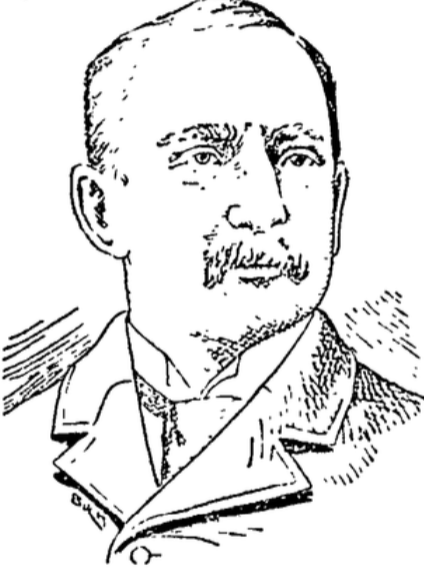
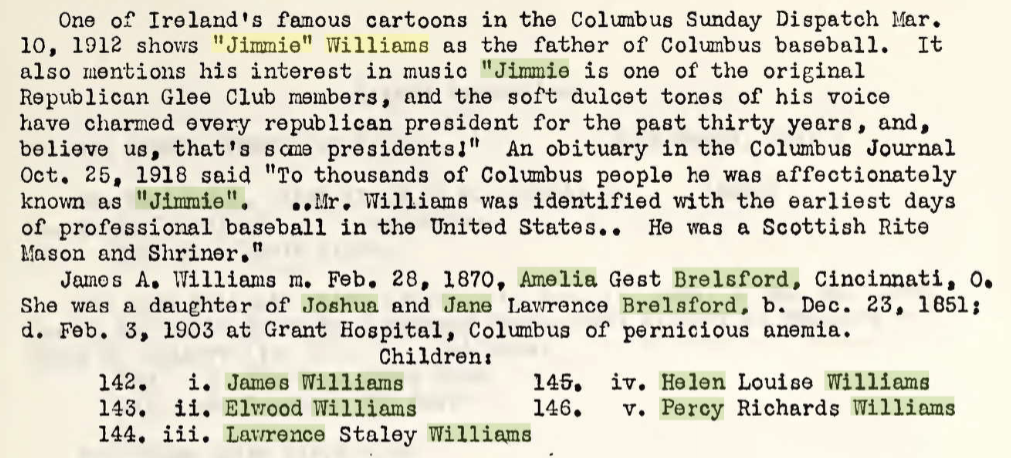
After that, Williams’ baseball life leaves the sports page and moves to the news pages as he becomes the clerk of the Board of Education for the state of Ohio in 1895, a role he would hold for more than a decade. Along the way, he (like his father) was an active member of the Republican Party. And he could sing – allegedly serenading several Republican presidents over his time as an active member in Ohio. At one point, he was put forward to be a state sentorial candidate, but elected office was not in Williams’ cards.
When his health began to fail him, Williams retired and took a long trip with his sons to Europe. He returned to serve as a banking clerk for a while before his health took a wound up becoming a bigger problem. He retired to Westbury, New York and lived with his son Elwood, until his death on October 23, 1918. His remains were returned to Columbus and he was buried near family in Green Lawn Cemetery there.
James was a young man when he met and married Amelia Gest Brelsford. They had five children together, however two (James and Helen) died as toddlers. Amelia was active in Columbus social and charitable circles, serving on the boards of member of the board of managers for the Home of the Friendless and the Home for the Aged. One son, Elwood became an architect in New York City who contributed to the plans for the St. Louis World’s Exposition, among other projects. Another, Lawrence worked in the art department of Charles Scribner and Sons Publishing (New York). The youngest son, Percy, has been harder to track. He was involved in some larcenies in Boston, once jumping bond and returning to Columbus to avoid penalties. The Columbus papers were, um … interesting in noting that Percy came from a good family without specifically mentioning the names of his parents. Percy later died in a tuberculosis sanitarium in New York in 1933.
Sources:
1850, 1860, 1870, 1880, 1900, 1910 US Census
New York Death Records
Ohio Marriage Records
“Base Ball Match,” Daily Ohio Statesman, July 15, 1867: 3. (Includes Box Score Image)
“Local Facts and Fancies,” Columbus Daily Dispatch, January 2, 1873: 6.
“Base Ball,” Columbus Dispatch, May 14, 1874: 3.
“Mr. James A. Williams,” Columbus Evening Dispatch, May 19, 1877: 4.
“The American Association,” The Sporting News, December 19, 1883: 2.
“Manager Williams’ Bereavement,” St. Louis Post-Dispatch, March 24, 1884: 5.
“Resignation of Manager Williams,” St. Louis Globe-Democrat, September 5, 1884: 10.
“Tampering with McKean,” Rochester Times-Union, January 13, 1887: 2.
“The State League,” Columbus Dispatch, February 21, 1888: 1.
“Sun-Stroke Causes Death,” Columbus Dispatch, July 10, 1888: 1.
“Ohio Flashes,” Dayton Herald, July 14, 1888: 5.
“Glee Club’s Reunion,” Columbus Evening Dispatch, July 15, 1890: 6.
“Sporting Notes,” Columbus Dispatch, December 22, 1890: 2.
“Williams considered for assistant manager position with the Phillies,” Columbus Dispatch, February 14, 1891: 2.
“Hurrah For Us!,” Columbus Dispatch, January 22, 1892: 2.
“Happy Milwaukee,” The Sporting News, January 23, 1892: 10.
“Spark of Life,” Columbus Dispatch, February 29, 1892: 2.
“Below the Limit,” Columbus Dispatch, March 5, 1892: 2.
“Ready for the Opening,” Columbus Dispatch, May 11, 1893: 2.
“The School Board,” Columbus Dispatch, February 20, 1895: 8.
“Capital City League,” Columbus Dispatch, May 1, 1896: 12.
“Glee Club Entertained,” Columbus Dispatch, October 27, 1899: 5.
“Larceny of a Watch,” Boston Globe, September 28, 1902: 2.
“Mrs. J. A. Williams Dead,” Columbus Dispatch, February 3, 1903: 8.
“Breveties,” Columbus Dispatch, March 11, 1903: 12.
“History of Early Columbus Amateur Baseball Games,” Columbus Dispatch, March 22, 1903: Section 2, Page 10.
Columbus Dispatch, February 24, 1904: 8.
“Breveties,” Columbus Dispatch, February 26, 1904: 13.
“Pages of Former Days in Reunion,” Columbus Dispatch, June 24, 1904: 6.
“First Baseball Game Played in Columbus,” Columbus Dispatch, December 18, 1904: 21.
“J. A. Williams May Decide to Resign,” Columbus Dispatch, April 3, 1906: 2.
“Williams Leaves the School Board,” Columbus Dispatch, April 10, 1906: 12.
“Return from Abroad,” Columbus Dispatch, October 31, 1906: 13.
“He Was No ‘Sir,’” Columbus Dispatch, November 6, 1906: 4.
“Good Citizenship Program Carried Through County Republican Caucus,” Columbus Dispatch, June 1, 1912: 1.
“Karshner Makes Good His Promise For Clean Politics,” Columbus Dispatch, June 2, 1912: 1.
“His Weary Body Now at Rest,” Columbus Dispatch, October 25, 1918: 26.
“Veteran Fan Dead,” Cincinnati Enquirer, October 25, 1918: 5.
“The Sport Mirror,” Columbus Dispatch, October 25, 1918: 26.
You can find an old Toledo Bee article about Williams here, which provided a few of the details you see here.
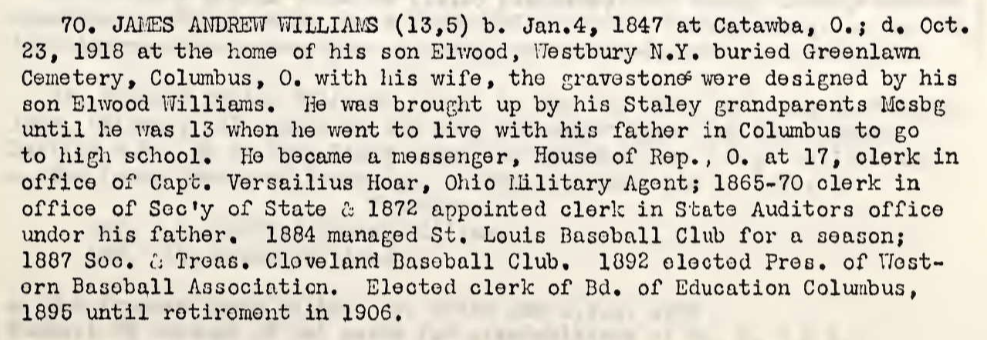
Ancestry.com has a Family History document associated with Williams; I’ll just include the screen shots for your reading pleasure here.
 Mighty Casey Baseball
Say, hello! Leave a comment!!!