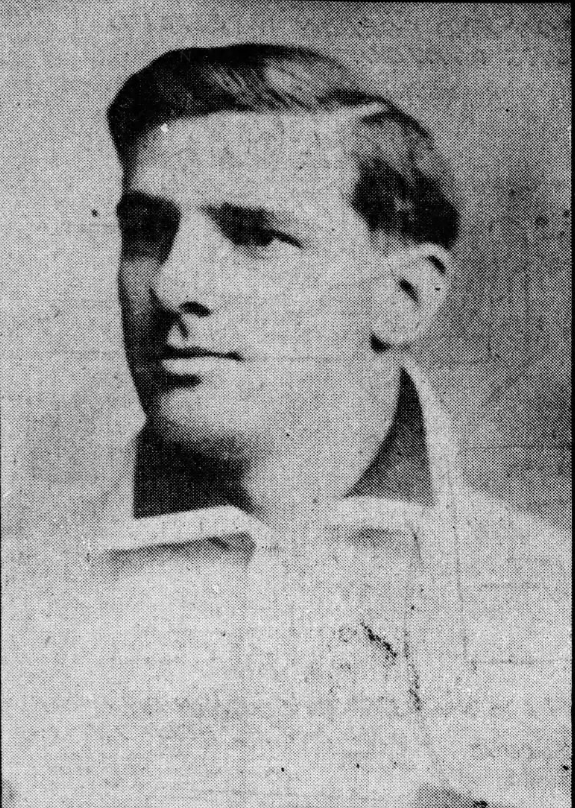
Legend has it that Clarence Currie’s baseball life blossomed when his future wife took an interest in Currie at a Wisconsin state league baseball game in 1901.
Clarence Franklin Currie was born December 30, 1878 to Robert and Jane (Eddie) Currie in Glencoe, Ontario, Canada (though his grave marker and World War I registration card says he was born in 1879). He spent his adult life in Michigan, Minnesota, and Wisconsin once the new century began. His major league career lasted two seasons, starting with Cincinnati, then moving to St. Louis and finally to Chicago – a midseason sale and release occurring in 1902 and 1903, respectively. He’d go 15 – 23 with a 3.39 ERA during the dead ball era; not a horrible line but not a winning one, either.
In fact, Currie was scheduled to be released by the Reds in July 1902 following a pair of poor showings in exhibition games against minor league teams and two horrible starts against Pittsburgh (eight runs in 1.1 innings) and Brooklyn (14 runs in a complete game loss). However, to the surprise of many, Currie fired a shutout to beat the New York Giants on July 14, 1902, which at least temporarily saved his brief MLB career. He was sold to St. Louis a week later and pitched well for that team in the final two months of the season. The Cardinals, its team raided by the American League St. Louis Browns, struggled in 1903 and eventually released Currie, who then signed with Chicago for the last month of that season.
That said, Currie had several fine outings, including a last-minute replacement start on Opening Day in 1903 for the Cardinals in which Currie topped the Cubs, 2-1, allowing just four hits – his own error ruining the shutout. And, he once threw 16 innings of relief for St. Louis in a game that ended in a 7-7 tie after 18 innings.
Currie’s career lasted several more years in the minors. His Baseball-Reference page shows him pitching professionally through 1907, including winning nearly 50 games for Toronto in the Eastern League between 1904 and 1906. After struggling in 1907 for Buffalo, he was released and returned to Appleton. However, Currie pitched for low level clubs for several years in Wisconsin and Minnesota. In 1912, he pitched and managed a semi-pro team in International Falls, Minnesota with some success. His obit later claimed he moved back to Appleton, Wisconsin in 1918. As an aside, his brother William also played semi-pro baseball in Wisconsin.
The best story I found about Currie hit the wires in 1903, explaining how Currie both met his wife and chased his baseball dream.
“When pretty Meta Scherck, daughter of William B. Scherck, a prosperous manufacturer of Appleton, Wisc., went to a Wisconsin state league game at her home in 1901 and told little Clarence Currie, the pitcher for the local club, that she knew he could make more money as a slab artist than he could by pursuing a business calling, she did not know that she had decided the blushing young man on his future career and had unwilling laid the Cupid snare that caught her subsequently and caused her to walk to the altar with this young ballplayer.”
The article went on to note that Currie was “not bigger than a pint of cider” (which was a stretch – though he may have seemed smaller than his listed size of 5′ 10″ and 170), that his future father-in-law prepared to provide Currie with a career at a business in Hart, Michigan (near where Currie lived at the time), and that Currie’s career jump came when the Muskegon amateur was signed to pitch for Appleton in 1900. Currie started slowly and was allegedly ready to return home when Ms. Scherck introduced herself to the young pitcher. Inspired by her kind words and bright eyes, Currie would go on to win his next seventeen starts, pitching Appleton to the league pennant. (A local article claimed his record as a pitcher was 24 – 4 for Appleton.) When the season ended, there was no point in leaving Appleton when he could work for Mr. Scherck there and pursue his relationship with Meta. (They, naturally, won a dance contest together.)
That fall, Currie signed with Reds scout Ted Sullivan and earned a tryout with Bid McPhee’s Reds in spring training. And the rest, as they say, is history…
Currie eventually returned to Appleton. Meta (sometimes spelled as Maeta) and Clarence raised a son and a daughter and enjoyed three grandchildren. For more than two decades, Currie operated bowling alleys in Appleton and Little Chute, Wisconsin – and for many years he was a top bowler in various tournaments in the state. Currie passed to the next league on July 15, 1941. Meta preceded Charlie in death by five years. He was buried in Highland Memorial Park in Appleton.
Notes:
1910, 1920, 1930, 1940 US Census Records
World War I Registration Card
Wisconsin Marriage Record
“Base Ball the Fourth,” Appleton Crescent, July 3, 1900: 3.
“Some Crack (P)Layers,” Oshkosh Northwestern, May 16, 1901: 1.
“Currie Signs With Cincinnati,” Appleton Crescent, October 5, 1901: 7.
“Caroline Lodge Dance,” Appleton Crescent, November 13, 1901: 3.
“Banny Is Ready to Tear Up Release Papers,” Cincinnati Post, July 15, 1902: 2.
“Beginning of Currie,” Paxton Daily Record, April 3, 1903: 3.
“Currie Puzzles Selee’s Batters,” St. Louis Post-Dispatch,” April 17, 1903: 14.
“Artie O’Dea Lining Up Fast Ones for Superior,” Duluth News Tribune, January 23, 1910: 23.
“Currie Making Good,” Virginia Enterprise, July 5, 1912: 6.
Obit, Meta Currie, Appleton Post-Crescent, April 22, 1936: 4.
“Former Cub Pitcher Dies,” Appleton Post-Crescent, July 15, 1941: 4.
“Former Card Hurler Clarence Currie Dies,” St. Louis Globe-Democrat, July 16, 1941: 12.
Gordon R. McIntyre, “Chaff’n Chatter,” Appleton Post-Crescent, July 18, 1941: 16.
 Mighty Casey Baseball
Say, hello! Leave a comment!!!