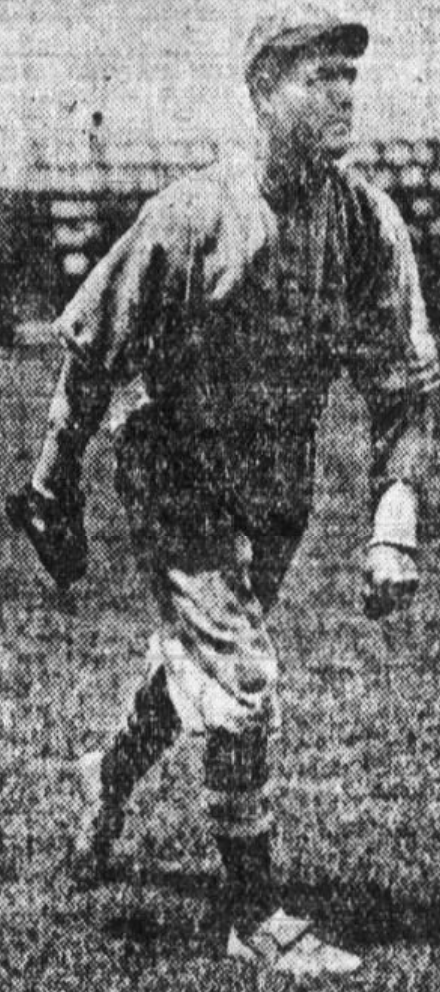
Tommy Quinlan’s baseball career stalled by joining the US Army for World War I. He nearly made it through the war unscathed. In the days leading up to the armistice that ended the war, Quinlan’s unit maneuvered to take out a machine gun nest. He survived, but he left his throwing arm in Europe.
Thomas A. (Finners) Quinlan was a Scranton man – born and died in that Pennsylvania town – and served his community in various civic roles until his death from pneumonia (complicated by diabetes) at 78 on February 17, 1966.
In between, he was a mobile outfielder (if not especially fast) starting with the local teams of his youth, through professional minor league teams in Scranton and other regional leagues. By 1913 he was given his first shot with the St. Louis Cardinals that September. His first major league RBI came off Christy Mathewson – it was a game winning single to center that scored the lone run in a ten-inning contest. It was the second game of a September 19, 1913 double-header – and the second hit for Quinlan, who batted leadoff that day. (Trivia: the game featured no strikeouts by batters of either team.)
Such heady days were few, however. Batting .160 in 50 at bats meant he was dispatched to Oakland in the Pacific Coast League. He hit .290 with 203 hits (in 180 games) for the Oaks, earning a second shot in 1915 with the White Sox. Quinlan’s fiery play during spring training got him a shot as the regular left fielder and the top spot in the batting order. However, Quinlan failed to hit (.193) here, leading to his return to Salt Lake City in the PCL. The Bees liked Quinlan’s play and he returned to Salt Lake City for the 1916 and 1917 seasons, too. His best season was in 1916 when he got 241 hits, batting .313 and adding 49 doubles to his team leading totals.
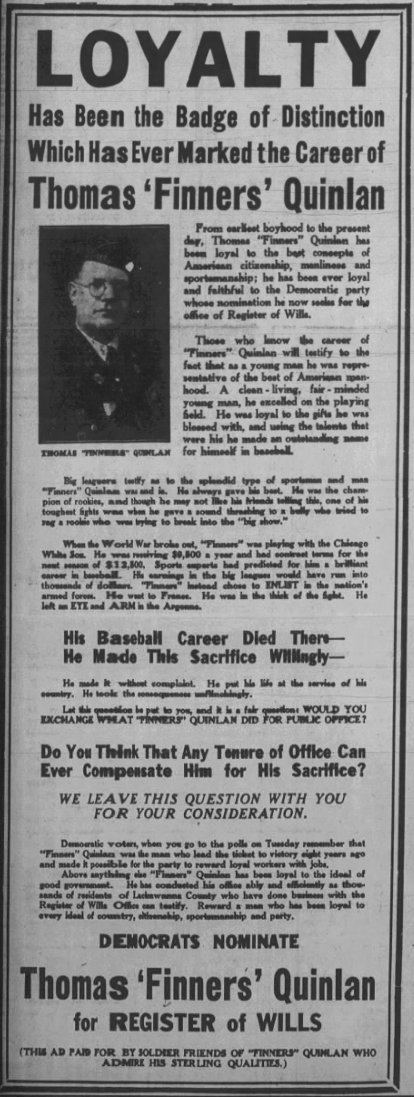
With World War I looming, Quinlan took a position at a munitions plant in Scranton for 1918, but his draft number was called; in July 1918 Quinlan joined the US Army. After completing training, he was dispatched to Europe as a private in Company K of the 28th Infantry and saw battle in France’s Argonne Forest. The war was nearly over – literally two days from the date the armistice was signed – when Quinlan took part in attacking a German machine gun nest. However, he was hit by enemy fire and shrapnel, costing him his left eye and his left arm. After his recovery at Walter Reed Hospital, Quinlan returned home to Scranton and got involved in the local Democratic political machine, serving as a city and county commissioner and in other civic positions for most of the rest of his life.
Born October 21, 1887, Quinlan was the son of Michael and Mary (Evers) Quinlan. In 1940 Quinlan told the census enumerator that he stopped attending school after the fourth grade and took on labor roles when not playing baseball. He married Louise Leyn and they had one daughter, Delores. After his death, he was buried in St. Catherine’s Cemetery in nearby Moscow, Pennsylvania.
Notes:
PA Birth Certificate, Death Certificate
World War I Compensation and Service Records
1940 US Census
“Quinlan Very Cool, So Says Writer,” Scranton Times, September 20, 1913: 11.
“‘Finners’ Quinlan Will Enter Army,” Scranton Tribune, July 9, 1918: 7.
“Quinlan Seriously Injured in Action,” Scranton Times, November 30, 1918: 11.
“New Int’l League Player Seriously Wounded in France,” Buffalo News, December 6, 1918: 27.
Campaign Ad, Scranton Times, September 8, 1941: 25.
“Thomas Quinlan Dies; Held Several Offices,” Scranton Tribune, February 18, 1966: 3, 10.
 Mighty Casey Baseball
Say, hello! Leave a comment!!!