{This was originally published ten years ago (April 8, 2015) and modified some after that when I revised the Poll Perritt bio for SABR. I decided to give it a clean up here in 2025 and republish the article.}
It’s time to reconsider the legacy of John McGraw. If Rob Manfred gets to review Pete Rose’s case and consider reinstating him, perhaps Manfred should review the history of John McGraw and consider kicking McGraw out and having him removed from the Hall of Fame.
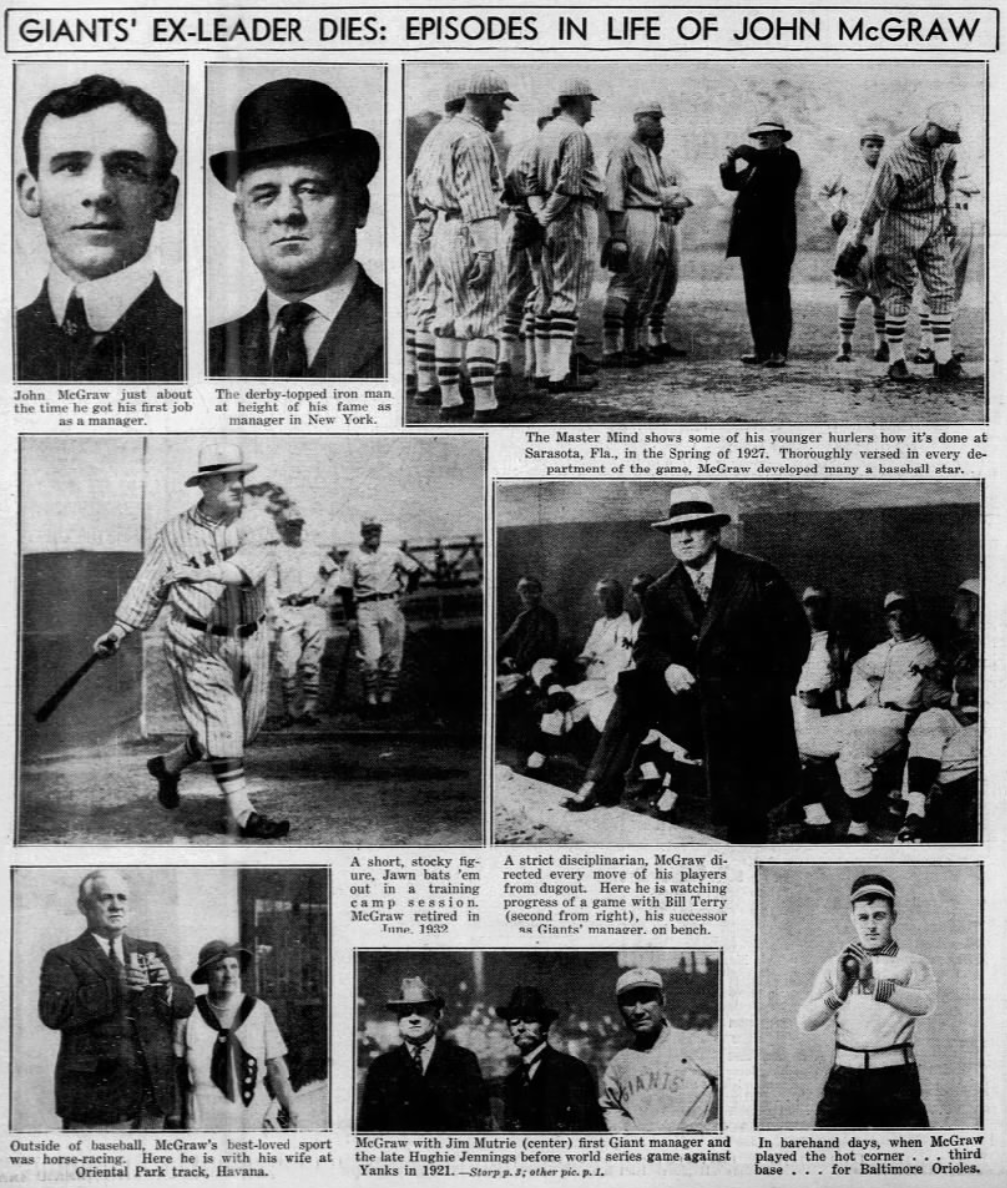
How did I come to this conclusion? I had thought about it for a little while (see my article on Poll Parrott), but it really came clearer to me in recent weeks. I was doing some research on Horace Fogel; it was his birthday a few weeks back and I couldn’t remember who he was, but it gave me a reason to think about John McGraw. I even bought two books about him – a biography and his autobiography.
Long and short, I no longer think John McGraw is one of the greats of the game of baseball. Rather – I think he was one of the villains. He’s Aaron Burr with better press and a better final act.
As a player with the Baltimore Orioles, McGraw had a reputation as a cheat. As a baserunner, he cut bases; as a defender he grabbed players to prevent them from running around third. He tripped people, he grabbed belts. The reason we need four umpires (if not six) at a ball game is because of guys like McGraw. He menaced umpires and other players – when he retired nobody had been thrown out of more baseball games than John McGraw.
Very noble.

It didn’t end there. McGraw somehow was made the manager of the AL’s Baltimore Orioles. Always running in harms way with the umpires, McGraw got on the wrong side of AL President Ban Johnson. So what did McGraw do? He worked out a deal with the New York Giants and Cincinnati Reds. He took over managing the Giants – stole many of the best Oriole players (some went to the Reds, who were in cahoots with the Giants since the former owner of the Reds was now the owner of the Giants) – and wrecked the Orioles. Johnson was so angry, he moved the Orioles to New York and set up the Yankees, which – given the status of the Yankees now – is quite the revenge.
McGraw was a successful manager for the Giants – don’t get me wrong – but given a chance to play in the 1904 World Series, McGraw said no. He was still mad at Ban Johnson, but he may have been worried about losing to the AL champions, since Boston had beaten Pittsburgh in the first World Series in 1903. McGraw won the 1905 series behind the pitching of Matty and Iron Man McGinnity, but the Athletics were without their ace, Rube Waddell in the post season. The Cubs and Pirates would take over the top spot in the NL starting in 1906 and the Giants would frequently finish third behind those two clubs.
In the next decade, the Giants were consistently good – but rumors abounded that the Giants had help. Here’s where Horace Fogel comes in – he ran the Phillies in the early 1910s. He was a front for the owners of the Cubs and a guy affiliated with the Reds, but he was the president of the team. Anyway – Fogel was having a rough year – he had invested in good players and they were competitive, but then things went the wrong way. A player got suspended, another key player got hurt, and the team fell down the stretch. At some point, Fogel said things he probably should not have said – but some of the things he said were coming from the guy who owned the Cubs. One of the things Fogel claimed was that in the height of the pennant race, the St. Louis Cards deliberately played to lose when facing the Giants, which helped the Giants win the pennant.
Roger Bresnahan was the manager of the Cardinals – he had become a manager because McGraw took the raw, fiery pitcher with crazy athletic skills and turned him into an outfielder and then a Hall of Fame catcher (not that there was a Hall of Fame then). Roger doesn’t get this job without McGraw having helped him as a player, and then by providing Bresnahan with quite the letter of recommendation. Fogel claimed that Bresnahan returned the favor by helping the Giants win the 1914 pennant, in part, by folding games when facing the Giants.
(In fairness to McGraw, the Giants didn’t win the pennant – they lost to Boston. And, as it turns out, the Cardinals handled the Giants. In the six series they played against each other, the teams split four of them evenly and the Cardinals won two others taking three of four, including one late in the season when the Giants needed wins. Overall, the Cardinals won 14 of 24 games with the Giants that year.)
Fogel was brought before the National League owners and management team, where they decided that they needed to shut Fogel up and kick him out of baseball. Fogel couldn’t really prove anything; but he was saying things the league didn’t want to talk about, so it was easier to make Fogel – who had no real ownership in the Phillies – go away.
That said, McGraw got in hot water two years later.
When his best friend, Wilbert Robinson, had a chance to win the 1916 NL pennant, whose team was it that threw games to Brooklyn at the end of the season to help Robinson get that pennant? That was McGraw’s Giants. Poll Perritt knew the game in which he was pitching was being thrown – so Perritt chose to make exaggerated errors on the bases or in the field to shed light on what McGraw and his cronies were doing. Despite some harsher commentary in the newspapers, nothing was done about it. (You can read about it in Perritt’s bio. See the link…)
In 1918, Perritt was pitching for the Giants when Hal Chase tried to extract some information from Poll in hopes to make money on a doubleheader (something Hal Chase did a lot, you know – he looked for information, and often included cash offers). Perritt told McGraw about it, word got out, and Chase was brought before a league tribunal to account for his actions. John McGraw testified about what Perritt said to him. Somehow, Chase got away with it. To top it off – McGraw then signed Chase to play first base for his New York Giants.
How does that happen?
McGraw was very good friends with the guy who ran a gambling syndicate (actually, a crime ring) in New York, Arnold Rothstein. They owned a race track together, among other things. Two players on McGraw’s 1919 Giants – Chase and Heinie Zimmerman worked with Rothstein to throw the 1919 World Series. Makes you think that Rothstein saw an opportunity to make some extra money and had his friend, McGraw, give Chase a job.
After the Black Sox scandal, the Giants were still among the best teams of the National League and won pennants to start the 1920s. They shared the Polo Grounds with the New York Yankees – oddly, the team that was created when the McGraw’s Orioles franchise was returned to the American League and moved to New York in 1903 – first as the Highlanders, and eventually taking on the Yankees moniker. Over time, the Yankees proved to be the more popular (and more successful) team – so McGraw, who was now a part owner of the team, worked to kick the Yankees out of the Polo Grounds.
McGraw’s reward was to lose a tenant, and then never win another pennant. Sure – he won a lot of games until he called it a career, but he never made it to another World Series after 1924.
If you think about this – what is it, exactly, that makes you think that John McGraw should be treated like one of the greats of the game? It’s like saying Pete Rose deserves to be in the Hall of Fame because he has 4200+ hits – so what if he broke one of the cardinal rules of baseball. Maybe THE cardinal rule. McGraw cheated on the field, he directly affected the outcomes of pennant races by accepting other teams laying down for his benefit and he had his own players throw games to help Wilbert Robinson. He cultivated a world of gambling on his own team that contributed to the fixing of a World Series. He was belligerent; he was pompous; he was corruptible, if not corrupt.
Oh, yeah – he was a great judge of talent.
 Mighty Casey Baseball
Say, hello! Leave a comment!!!