BIRTH ANNOUNCEMENTS:
1856 Charles Joseph (Curry) Foley
1867 Bill Kling
1868 John Newell
1871 Art Madison
1876 Bill Wolff
1880 Paddy Livingston
1882 Frederick Joseph (Cy) Alberts
1885 John Grover (Nig) Perrine
1885 Todd Allen
1891 John Shovlin
1893 Billy Meyer
1894 Art Decatur
1898 Dick Wheeler
1899 Ralph Miller
1902 Smead Jolley
1903 Russ Scarritt
1907 Chet Brewer
1911 Hank Gornicki
1915 Bob Joyce
1922 Hank Biasatti
1923 Ken Johnson
1930 Pete Daley
1937 Wilfred Charles (Sonny) Siebert
1939 Tim Talton
1942 Dave Campbell
1942 Billy Parker
1943 Ron Clark
1943 Dave Marshall
1951 Derrel Thomas
1952 Terry Forster
1952 Wayne Gross
1954 Danny Boone
1957 Tony Brizzolara
1959 Jeff Keener
1960 Ross Jones
1961 Joe Redfield
1962 Gary Green
1967 Paul Fletcher
1970 Steve Cooke
1973 Troy Brohawn
1973 Rod Myers
1974 Mike Frank
1976 Pat Daneker
1984 Mike Pelfrey
1984 Erick Aybar
1987 Logan Forsythe
1989 Adam Kolarek
1990 J. R. Graham
1991 Stephen Piscotty
1991 Aaron Altherr
1993 Boog Powell
1993 Dovydas Neverauskas
1997 Pedro Avila
1998 Sam Huff
OBITUARIES:
1892 Silver Flint
Frank Flint, catcher for great Chicago teams of the 1880s, died of tuberculosis in Chicago at the age of 36.
“Game of Life Over,” Boston Globe, January 15, 1892: 2.
1895 Ed Silch
Silch came from St. Louis, which was a hot bed for baseball players by the 1880s. Brooklyn took a chance on the pitcher-turned-outfielder and gave him 14 games to see if he’d pan out. Silch didn’t exactly fail – he hit .271 and was a better than league average hitter. If he was a bit error prone, it wasn’t a huge problem. Buffalo, which had a very good minor league team chose to purchase his services instead. The kid saw a lot of the United States riding the rails. He returned home and took a position as a motor man on a trolley line in St. Louis.
Half a decade later, Silch advanced to the next league when he died of consumption some 30-odd days before his 30th birthday.
“Ed Silch Dead,” St. Louis Post-Dispatch, January 16, 1895: 7.
1908 Henry (Heine) Krug
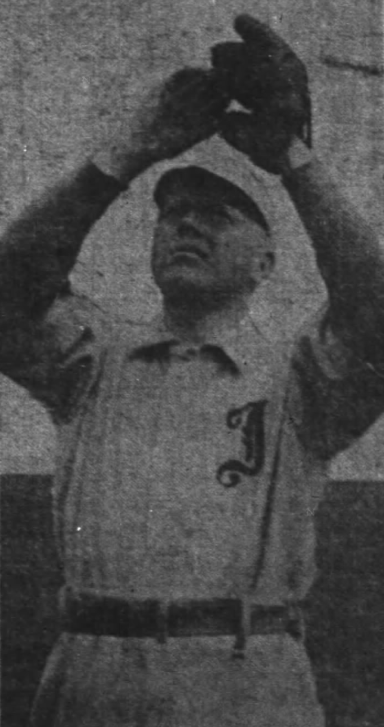
Krug, a relatively famous and popular baseball player in his hometown of San Francisco, died after a short bout with pneumonia. Krug was still an active player, having just turned 31 after finishing a season with Indianapolis.
His lone season in the majors was with Philadelphia in 1902. As a Phillie, he played left field, second base, short and third – however despite his best efforts, he didn’t stick. (He hit but .227 with no secondary benefits like speed, power, or on base percentage boosts). That’s not to say that he might not have had the skills to play in the majors – but that he was likely more comfortable playing on the West Coast. When he returned to San Francisco to play in the recently created Pacific Coast League, he had 231 hits in 217 games. (They played unusually long seasons in the early days of the PCL.)
Krug would return east, but in lower level leagues, such as Atlanta, Scranton, and Indianapolis. In 1907 he suffered knee and leg injuries (charley horses that wouldn’t heal – so hamstring or quad injuries, right?) in Indianapolis, which led to his losing playing time and, eventually, his job. He was sold to Johnstown in December 1907.
Three weeks later, Krug died.
“Infielder to Get Needed Rest,” Indianapolis News, May 27, 1907: 10.
“Probably Has Played Last Game as an Indian,” Indianapolis News, September 3, 1907: 10.
“Himes and Krug Go To Johnstown Club,” Indianapolis News, December 26, 1907: 8.
“‘Heine’ Krug Dies at Home in San Francisco,” Oakland Enquirer, January 15, 1908: 8.
“‘Heine’ Krug is Called by Death,” San Francisco Examiner, January 15, 1908: 8.
1908 Sim Bullas
Bullas died of pneumonia at 45 in his Cleveland home.
1909 Togie Pittinger
1913 Hal O’Hagan
1920 William Hyndman
1928 Al Reach
1929 Fred Hayner
1931 Hardy Richardson
1931 Slim Norris
1935 Irv Young
1937 Ed Trumbull
1945 Ted Blankenship
1948 Art Benedict
1948 George Carr
1950 Bill Thomas
1952 Rube Sellers
1953 Charlie Small
1958 Percy Miller
1959 John Ganzel
1961 John Cavanaugh
1962 Pep Young
1962 Les Mann
1963 Johnny Robinson
1965 Ellis Johnson
1965 Bill Hopper
1966 Tacks Neuer
1968 Bill Black
1970 Johnny Murphy
Murphy was a Yankee pitcher, but was the general manager of the Miracle Mets and was barely three months removed from watching that victory when he had a heart attack.
1974 Lloyd Brown
1974 Jay Partridge
1982 Jesse Hubbard
1994 Sam Vico
2000 Bud Barbee
2001 Joe Zapustas
2003 John Ritchey
2006 Bubba Morton
2008 Don Cardwell
2009 Mike Derrick
2019 Dick Brodowski
2019 Eli Grba
2019 Jim Clark
2021 Ron Samford
Samford was weeks away from turning 91 when he passed away in his Dallas home; he left and entered this world in that city.
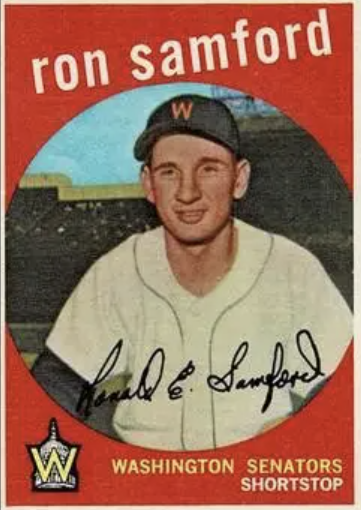
In his baseball career, Samford was a Giants farmhand given his first shot in 1954. He was waived and signed by Detroit, who gave him a smaller cup of coffee in 1955. The Tigers brought Samford up and gave him more regular time in 1957 – he served as a utility infielder and pinch hitter (or fielder, as the case may have been). His lower batting average and lack of power made him expendable by 1958.
The 1950s was fun for its collection of trades that included large numbers of players. In this case, Samford was traded with Reno Bertoia and Jim Delsing to the Washington Senators for Rocky Bridges, Neil Chrisley, and Eddie Yost. It worked out for Samford in that he got to play more. Samford appeared in 91 games, 64 at shortstop, and despite being in one of the toughest places to hit homers, he finally hit five with the Senators.
His homer stories are a bit deceptive, however. Samford hit all five of his Senators homers in road games. Also, his obit notes that in his last major league at bat he homered. This Samford did; he hit a three-run homer off Ernie Johnson to finish an extra-inning rally to beat Baltimore. However, it wasn’t his last plate appearance – a few days later he pinch-hit and bunted for a sacrifice. No at bat.
His major league career ended, but his baseball career continued to 1963 – some fifteen years after his career began when signed by the Giants for 1948. He and a family member opened Texas Automatic Transmissions Parts, Inc., which he ran for several years before retiring. He was also president of the Ex-Pro Baseball Players Association of Texas.
2021 John LaRose
LaRose pitched a single game in relief for Boston in 1978; it was an outing of mixed results. He got out of a jam in one inning and a couple of innings later he gave up a homer to Lou Whitaker. Don Zimmer remembered the homer and LaRose’s major league career ended. According to Bill Nowlin’s SABR biography, LaRose eventually became a dealer at the Foxwoods Casino, which is what he was doing when he passed to the next league.
YOU SHOULD HAVE BEEN THERE!!!
1954 Joe DiMaggio and Marilyn Monroe elope… The marriage lasted just 274 days.
1976 Ted Turner purchases the Atlanta Braves for $12 million.
TRANSACTION WIRE:
1940 A bunch of Detroit Tigers, including Johnny Sain, are granted free agency when commissioner Judge Landis ruled that 91 players on the Tigers roster or in the farm system had been restricted unfairly by the team. In addition to the release of 91 players, nearly $50,000 was handed out to fourteen players in additional compensation.
1963 The White Sox send Luis Aparicio and Al Smith to the Orioles for Hoyt Wilhelm, Ron Hansen, Pete Ward, and Dave Nicholson.
1964 Pittsburgh signs amateur free agent pitcher Dock Ellis.
1986 First round picks for the January secondary draft included: Moises Alou (Pittsburgh), Kevin Brown (Atlanta), and later Curt Schilling (Boston – 2nd round).
2008 Toronto sent Troy Glaus to the Cardinals for Scott Rolen.
 Mighty Casey Baseball
Say, hello! Leave a comment!!!