BIRTH ANNOUNCEMENTS:
1847 Herb Worth
Credited with a single game for the Brooklyn Atlantics in 1872, which was then a team in the original National Association. He got a hit – it was a double – and he drove in a run.
1862 Ollie Beard
I first heard about Ollie Beard when writing about Rube Waddell. By then, he was more of a player-manager, being brought in temporarily to run the Detroit Wolverines of the Western League in 1898. At that point, a Detroit writer called him a refrigerator playing second base – which has to be one of the original uses of kitchen appliances to describe an overweight player.
Anyway, Beard played in the majors – he was a regular for the Cincinnati Red Legs in 1889 and followed the Red Legs when it moved from the American Association to the National League in 1890. That gig didn’t last long – he found work with Louisville in 1891 and didn’t hit as well as he had the previous two seasons and was dispatched to the minors, where he spent at least a decade down there… His batting average followed his career path – after hitting .285 in his first season with a fair number of extra base hits and 36 stolen bases, he fell off to .268 with just 30 steals, and in 1891, he was down to .241 with half the extra base hits and only seven steals – hence his demise.
1866 Reddy Mack
American Association player during the second half of the 1880s, where he earned a job as a teen. Merely a tolerable hitter (usually around .240) except for 1887 where as a 21-year-old he batted .308 and drew 83 walks for a .415 on base percentage.
He never approached that again – and his days as a major leaguer ended after the 1890 season.
1876 Jack Morrissey
1886 Larry Cheney
1887 Eddie Collins

Briefly Rube’s teammate in 1907 while still in college (caught, costing him his college eligibility) – the finest second baseman who ever lived and he’d probably tell you why, too. The teams he played on won a lot… He appeared in six World Series, winning four (of course, one was thrown to the Reds). Bill James pointed out that not only did he play in four different decades, but he batted at least .340 in all four. (Collins went 1/2 in 1930, so…)
1891 John Leary
1891 Edgar Wesley
1896 Bill Piercy
1898 Lucas Turk
1899 Gale Staley

Short story? Was a bit of a prospect coming out of the Piedmont League in 1925 when the Cubs grabbed him and gave him seven games after joining the team in September. He hit well enough – 11 for 26 – but apparently was a bit error prone at second base. (And maybe they figured out he wasn’t really 21 or 23 as he said.) Anyway – he drifted west, played three years in Los Angeles and another with Portland in the Pacific Coast League before his career ended in 1930.
1899 Oran (Skinny) O’Neal
1902 Freddy Sale
1908 Walter Burch
1909 George Giles
1915 Whitey Miller
1915 Ken Richardson
1916 Tee Mitchell
1925 Ralph Brickner
1926 Sam Hill
1932 Eddie Bressoud
1939 Gates Brown
1941 Clay Carroll
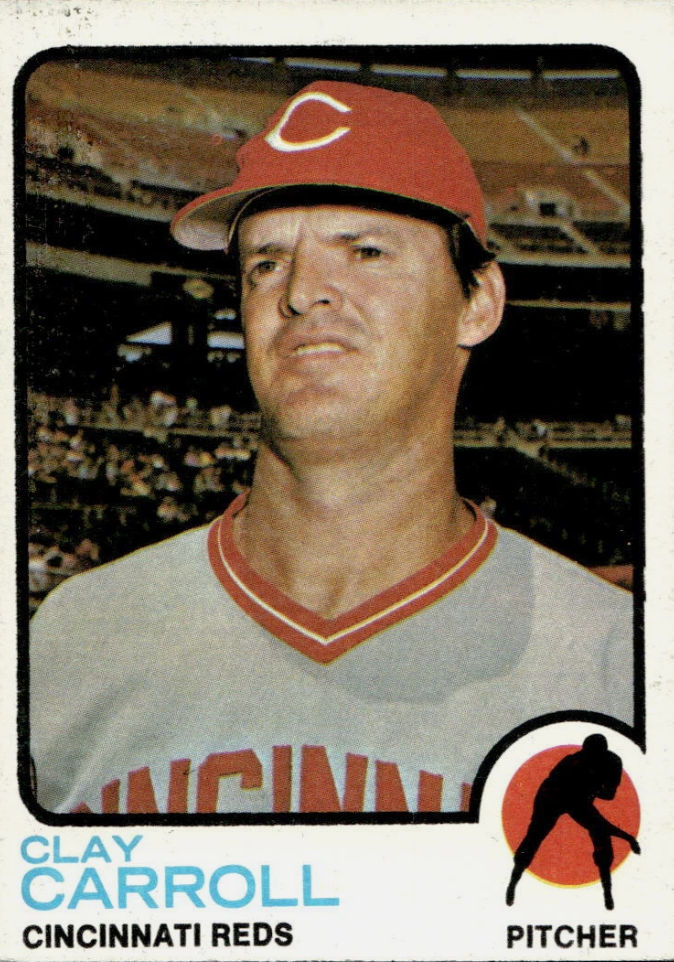
Not a huge strikeout guy, good but not great control – and yet as dependable a multi-inning reliever as you could find in the 1970s, huh? The Reds (when they had him) could pencil him in for 60 appearances, 120 innings, 10 wins and maybe 10 saves (he had 37 saves in 1972) each year. There was a Clay Kirby playing at the same time – the two Clays were teammates in 1974 and 1975 – and, in my head, I confuse the two. I was playing Immaculate Grid and the combination was San Diego and Cincinnati. I entered Clay Carroll – but it was Clay Kirby.
1948 Larry Gowell
1949 Steve Grilli
1954 Keith Moreland
Moreland was one of many players involved in trades between the Cubs and Phillies at a time when Dallas Green could raid his old friends for excess talent. When the Cubs were entertaining in the 1980s, Moreland was the right fielder. He became expendable when the Cubs signed Andre Dawson and it was the right thing to do to send Moreland to San Diego for the 1988 season.
Moreland would often hit about twice as many homers at Wrigley Field than on the road (most players who are regulars in Wrigley do) which made his stats look better than he actually hit, but he seemed like a decent, dependable, hard working player (as befitting a University of Texas football player) and the fans appreciated his blue collar approach. He played where he was needed, including a few games behind the plate and a season at third base. A very Chicago person – show up, do your best, help out anyway you can kind of guy. I hope he’s living a comfortable life these days.
1959 Brick Smith
1962 Jim Walewander
1965 Felix Jose
1970 Joe Crawford
1971 Brent Bowers
1975 Mark Johnson
1977 Luke Hudson
1985 Jose Ascanio
1985 Jarrod Saltalamacchia
1988 Neftali Feliz
1990 Erasmo Ramirez
1991 Jonathan Villar
1992 Yadiel Rivera
1994 Penn Murfee
1996 Luis Torrens
1997 Blake Rutherford
1998 Ian Anderson
OBITUARIES:
1902 Bill Greenwood
His obit in the Philadelphia Inquirer (May 4, 1902: 25) says he died suddenly, but without a death certificate or news article, we’re only guessing (heart attack?). The obit mentions his parents and a sister, but no wife or children. FindAGrave.com says he was married to a Leah Wright and they had at least two kids. In fact, she went back to Leah Wright after the divorce when she was raising both kids and living with her mother in 1900. For some reason, she goes back to being a Greenwood with the 1920 US Census…
William Fitter Greenwood got in five full seasons as a light hitting second baseman in the 1880s and 1890, but only hit more than his career average of .226 once.
1903 Odie Porter
Porter got a start for the Philadelphia Athletics in June 1902, about a week before Mack convinced Rube Waddell to ditch the Los Angeles Loo Loos and join Philadelphia. Porter, a Borden, Indiana native, was pitching for Bloomington and Mack brought him to Chicago to face the White Sox. It wasn’t pretty – 12 hits and 5 walks and ten runs scored. He wasn’t totally to blame as only three runs were earned. Apparently, the White Sox bunted and deliberately hit the ball up the middle toward Porter to test the rookie, leading to seven runs. Anyway… Not a positive impression. (The Inquirer lists his name as James, for what it’s worth.) Mack said after the game that Porter would be returned to Bloomington.
Speaking of Bloomington, Baseball-Reference.com notes that Porter attended the Indiana University – but the school, while acknowledging Porter’s attendance, says that Porter was never associated with the college baseball team while a student.
When not plying his trade as a ballplayer, Odie Oscar Porter, son of Eura and Abigail (Hogan) Porter, was a drug salesman, per the 1900 US Census. Less than a year after his MLB debut, he was gone. Newspapers to which I have access don’t mention Porter’s death. His FindaGrave profile suggests that he died of tuberculosis.
“White Sox Bump Pitcher Porter,” Philadelphia Inquirer, June 17, 1902: 10.
1908 Ed O’Neil
1944 Art Thomason
1945 Joe Corbett
Gentleman Jim’s brother, a pitcher with the Orioles and a 20 game winner as a rookie in 1897.
1947 Ossie France
1947 Joe Scott
1948 Dick Cogan
1950 Al Klawitter
1950 Jo-Jo Morrissey
1953 Fred Miller
1964 Sensation Clark
1965 Wally Hood
1969 Steve Larkin
1970 Art Delaney
1972 Jack Smith
1972 Hop Bartlett
1976 Dan Bankhead
1979 Lou Raymond
1982 Leo Callahan
1983 Archie Yelle
1983 Dewitt Owens
1988 Art Hefner
1989 Virgil Stallcup
1992 Cannonball Berry
1994 Buck Fausett
1996 Pinky Jorgensen
1997 Don O’Riley
1997 Jimmy Wilson (the Negro Leaguer and not the Reds catcher)
1998 Johnny Grodzicki
1998 Charlie Thomas
2004 Moe Burtschy
2015 Bob Schmidt
2016 Gordie Sundin
YOU SHOULD HAVE BEEN THERE!!!
1876 Chicago’s Ross Barnes hits the first homer in NL history against the Reds.
1917 Fred Toney and Hippo Vaughn both complete a no-hitter through nine innings – but the game is tied. Chicago scored two on the Reds in the 10th, and Vaughn completed his gem for the win.
1939 Benching himself for the good of the team, Lou Gehrig sits out ending his consecutive games played streak at 2130.
1954 Stan Musial hits five homers in a double header, a record.
1959 Frank Robinson completes the cycle, resulting in 5 RBI in a 16 – 4 slaughter of the Dodgers.
1984 Andre Thorton is the second player to get six walks in a game, contributing just one run in a 9 – 7 Indians win over Baltimore in 16 innings.
2002 Seattle’s Mike Cameron pounds out four homers in a game against the White Sox. Bret Boone followed the two with homers of his own, making them the first teammates to go back-to-back in the same inning. All four of Cameron’s homers were solo shots.
TRANSACTION WIRE:
1902 Pittsburgh sells Rube Waddell to the Chicago Orphans, allegedly for a box of cigars.
1924 Connie Mack signs Amos Strunk.
1963 Cleveland sends Jim Perry to the Twins for Jack Kralick.
1975 A day that crushed a young Paul Proia… The Cubs trade Burt Hooten to the Dodgers for Geoff Zahn and Eddie Solomon.
 Mighty Casey Baseball
Say, hello! Leave a comment!!!